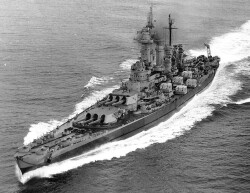
If blood indeed is the price of admiralty, then all sides paid full measure during the Second World War. Both the European and Pacific theaters included major battles and even whole campaigns at sea. As I got interested in WW2 primarily through naval warfare, this is what I have the most books about. They can be grouped into half a dozen or so major categories:
| Morison's History of the USN | General books about the war at sea | The Atlantic and Mediterranean |
| The Pacific and Indian oceans | Combat ship biographies |
Personal accounts and combat journals |
Samuel Morison's books about the United States Navy
Samuel Eliot Morison joined the United States Navy after the war began and served throughout the war. Much of his time was spent at sea in combat zones. After the war, he combined his combat experience with his skills as a historian and wrote a massive fifteen-volume series titled History of United States Naval Operations in World War II. This gigantic work covers all the US Navy's significant activities during the war, on all oceans and seas, in all parts of the world. It's a must-have for any serious student of the US Navy in the Second World War. It was reprinted in 2001 by Castle Books, and I was able to acquire a full set.
- As the first entry in the set, THE BATTLE OF THE ATLANTIC has to serve as introduction as well. So it talks about the time between the wars, and US naval strategy prior to its joining the war in December 1941. Morison discusses the 'short of war' period of fall 1941, when the US wasn't officially a combatant but helped escort British convoys anyway. From there, Morison moves on to the first fifteen months of US involvement in the Battle of the Atlantic: the disastrous U-boat assault along the US East Coast, the convoy battles of late 1942 and early 1943, US participation in the Russian convoys, and Mediterranean antisubmarine campaigns.
- OPERATIONS IN NORTH AFRICAN WATERS describes the US Navy's role in Operation Torch, the invasion of North Africa. Morison describes the entirety of this first major amphibious operation of the war, from initial planning through both major landings and the land campaign that followed.
- THE RISING SUN IN THE PACIFIC starts with the pre-war situation in the Pacific. Next, it describes the attack on Pearl Harbor in detail. Then it moves on to the events of the first five months of the Pacific War, up to the Doolittle Raid. Along the way, Morison describes the Japanese moves against Indonesia and the Philippines, and the heroic but hopeless defenses by the Marine garrison of Wake Island and the Army and Navy forces in the Philippines.
- CORAL SEA, MIDWAY, AND SUBMARINE OPERATIONS is about exactly what the title says. The first four chapters are about the Battle of the Coral Sea, the first carrier-vs-carrier battle of the war. Next comes four chapters about the pivotal Battle of Midway. The third section of the book is about submarine operations during the first year of the Pacific War, including the pioneering tactics and the incredible torpedo fiasco that so nearly wrecked the USN submarine forces. The volume closes with an account of the planning for Operation Watchtower (the retaking of the Solomon Islands) and the landings on Guadalcanal.
- THE STRUGGLE FOR GUADALCANAL covers the naval aspects of the six-month-long Guadalcanal Campaign, and gives significant space to the fighting ashore as well. The Guadalcanal Campaign included six major naval battles (Savo Island, Eastern Solomons, Cape Esperance, Santa Cruz, the gigantic three-day Naval Battle of Guadalcanal, and Tassafaronga) and dozens of lesser naval actions, including one of the two battleship-vs-battleship shootouts of the Pacific War. Morison covers every one of the major actions in detail and covers most of the lesser actions as well.
- BREAKING THE BISMARCKS BARRIER focuses on the series of amphibious landings, naval battles, and air combat that systematically destroyed the Japanese hold on the central Solomon Islands and the Bismarck Archipelago. I personally think that this phase of the war hasn't gotten nearly as much attention as it deserves. The naval war in the Solomons and Bismarcks is a story of small actions by handfuls of ships and small-craft against an evenly matched foe who gave as good as he got.
- ALEUTIANS, GILBERTS AND MARSHALLS deals with three Pacific campaigns of 1943. First is the fighting around the Aleutians, and the retaking of Attu and Kiska from the Japanese. Then comes a description of the conquest of the Gilbert Islands, including the hideously bloody assault on Tarawa. Next is the Marshalls campaign, along with the first major actions by the growing fast carrier forces such as the very effective two-day air assault on the Japanese fleet base at Truk in February 1944.
- NEW GUINEA AND THE MARIANAS first describes the series of amphibious actions by which General MacArthur, supported by Seventh Fleet and occasionally by the fast carriers, took back New Guinea from the Japanese. Then the action switches to the Marianas, where Morison describes the invasion of those islands and the great Battle of the Philippine Sea, the last major carrier-vs-carrier battle of the war.
- SICILY - SALERNO - ANZIO describes the US Navy's activities in the Mediterranean in 1943 and early 1944: the amphibious invasion of Sicily, the move to the Italian mainland at Salerno, and the amphibious flank strike at Anzio.
- THE ATLANTIC BATTLE WON describes the series of measures by which the U-boats were finally defeated in the Atlantic. It starts with a survey of the new anti-submarine measures introduced by the Allies in early 1943, including escort support groups, escort carriers, new weapons and new tactics. Next, Morison describes the "Bay Offensive" that made U-boat passages to and from port a living hell. Then he moves on to the North Atlantic convoy battles of spring 1943, in which forty-three U-boats were sunk in thirty days. The remainder of this volume explores the war fought by the US and British escort carriers against the U-boats, as well as anti-U-boat operations in the Mediterranean, in the Arctic, and in the English Channel during the cross-Channel invasion of France.
- THE INVASION OF FRANCE AND GERMANY describes the US Navy's role in Operation Neptune/Overlord, the invasion of France in June 1944. It also describes the invasion of southern France, and what role the US Navy played in the land war against Germany.
- LEYTE describes the Leyte Campaign of October 1944, from preliminaries such as the invasion of Peleliu to the battle for Leyte itself. Well over half of the book is given to an in-depth description of the great Battle for Leyte Gulf, the largest naval battle in history.
- THE LIBERATION OF THE PHILIPPINES is a detailed look at the series of amphibious operations which put American troops on all the major Philippine Islands and other islands in the Southwest Pacific, and defeated the Japanese defenders in each place.
- VICTORY IN THE PACIFIC describes the Iwo Jima and Okinawa campaigns, US submarine actions in 1945, defending against the Japanese kamikaze suicide tactics, and carrier raids and other naval operations against the Japanese homeland.
- The final volume in the set is a SUPPLEMENT AND GENERAL INDEX to the entire set. This includes ship class descriptions for every type of warship, supply ship, and auxiliary which served in the USN in WW2.
After completing the series, Morison condensed and rewrote it into a one-volume summary:
THE TWO-OCEAN WAR
Morison, Samuel Eliot (Rear Admiral USN, ret.)
c.1963, Atlantic Monthly Press
ISBN:
A single-volume treatment of the history of United States naval operations in the Second World War, condensed from Morison's History of United States Naval Operations in World War II. Much of the background information from the larger work is omitted, as are a number of smaller naval actions and amphibious landings, but Morison still manages to describe every significant US Navy action in every theater of the war at sea: North Atlantic, South Atlantic, Mediterranean, Central Pacific, South Pacific, and Southwest Pacific. If you want a top-quality reference on the US Navy in WW2 but can't afford the full 15-volume set of the History, this is a more than adequate substitute.
Other general books about the war at sea
These are general books about the naval war which don't focus on any specific ships or theaters of combat.
BLOOD ON THE SEA: American Destroyers Lost in World War II
Parkin, Robert Sinclair
c.1995, Sarpedon
ISBN: 1-885119-17-8
This book gives summary accounts of every USN destroyer lost in World War II, in all seas and all theaters. Unfortunately, it covers only destroyers, not destroyer-escorts.
ENGAGE THE ENEMY MORE CLOSELY
Barnett, Correlli
c.1991, W. W. Norton & Co.
ISBN: 0-393-02918-2
A general history of Great Britain's Royal Navy during World War II. This book effectively does for the Royal Navy what Morison's THE TWO-OCEAN WAR does for the US Navy. It discusses naval policy during the 1920s and 1930s, then covers all of the Royal Navy's actions throughout the war, including one of the few good accounts I have of the fighting between the Royal Navy and the Italian Navy in the Mediterranean in 1940-41.
JANE'S FIGHTING SHIPS OF WORLD WAR II
Various
c.2001, Random House
ISBN: 1-85170-494-9
The ultimate reference book on World War II combat warships. There is literally nothing better than Jane's as a source for military hardware. This book is a collection of data first published during or shortly after the war. It covers every class of combat ship from every combatant -- everything from battleships to motor torpedo boats, and not only the major sea powers such as the US, Britain, and Germany, but also lesser navies like Greece and Austria.
TIN CANS
Roscoe, Theodore
c.1960, Bantam Books
ISBN:
The official history of United States Navy destroyer operations in World War 2. Roscoe covers all theaters in both the Atlantic and the Pacific, and includes destroyer-escorts (DEs) as well as full destroyers (DDs).
The naval war in the Atlantic and Mediterranean
In the Atlantic Ocean, the naval war was primarily between the Allied navies and the German U-boat fleet. I've placed most of the books about the U-boat war on my submarine warfare page. However, there was also a surface-ship aspect, where Allied warships fought a number of actions against German surface raiders. There was also a major naval campaign fought in the Mediterranean, between the British Mediterranean Fleet and the Italian Navy. I've seen very few books about the Mediterranean surface-ship war. I do have a few books about the German raiders, both the regular surface ships and the armed merchant raiders. I've tried to organize these in rough chronological order.
VERY SPECIAL INTELLIGENCE*
Beesly, Patrick
c.1977, Ballantine
ISBN: 0-345-29798-9
The story of the Royal Navy's Operational Intelligence Centre during WW2. The O.I.C. was in charge of taking intelligence from all sources and coordinating it for the Admiralty. In the process of describing O.I.C.'s war, Beesly gives a very nice overview of the entire war at sea as seen by the Royal Navy's strategists and planners. Much of O.I.C.'s intelligence material came from "Ultra," the Bletchley Park codebreakers, but this book is not about codebreaking directly. It's about how the intelligence material was used in naval operations.
EAST OF MALTA, WEST OF SUEZ
Bartimeus (pseudonym for Paymaster Captain Ritchie, RN)
c.1944, Little, Brown & Co.
ISBN:
This is the British Admiralty's official account of the naval war in the Mediterranean between the outbreak of war in 1939 and the surrender of Italy in 1943. On the Allied side were the British Mediterranean Fleet with a few American warships added in; the Axis was represented by the powerful Italian Fleet and a few German U-boats. There were several major and many lesser actions between the two opposing forces. The Mediterranean naval war doesn't get nearly the attention it deserves. The Italian Navy was a large, well-equipped force with modern ships and professional crews, which could have fought the Royal Navy on even terms if not for its own High Command's refusal to commit it to full-scale battle.
SINK THE BISMARCK*
Forester, C.S.
c.1959, Bantam
ISBN: 0-553-10541-8
In May 1941, the great German battleship Bismarck attempted to break into the open Atlantic in order to raid British convoys. After six days of frantic effort, including the loss of the mighty battlecruiser HMS Hood and the damaging of several more RN ships, the Royal Navy finally brought her to bay and sank her. This book is a fictionalized description of the Bismarck's first and last sortie, written long before detailed accounts of the action became available to the general public. Being fiction, it misses a number of interesting points and gets a few things simply wrong, but in some ways it provides a more vivid picture of the hunt for the Bismarck than any of the factual accounts do. The classic war movie Sink the Bismarck! was based on this book and follows it fairly closely, with the addition of a subplot or two.
PURSUIT: The Chase and Sinking of the Battleship Bismarck
Kennedy, Ludovic
c.1974, Pinnacle
ISBN: 0-523-00647-0
I think this may be the best existing account of the Bismarck's brief life and violent end at the guns of the Royal Navy. THE DESTRUCTION OF THE BISMARCK (see below) has more detail and is closer to being complete, with its inclusion of declassified archives, but it fails to reproduce the sense of immediacy that Kennedy provides. Kennedy drew heavily on reminiscences from Bismarck survivors to tell her story, and on official records and witnesses from the Royal Navy ships to tell the RN's side. Kennedy himself was a crewman aboard HMS Tartar, one of the destroyers that fought the Bismarck, so he has first-hand experience of the battle.
THE DESTRUCTION OF THE BISMARCK
Bercuson and Herwig
c.2001, Overlook Press
ISBN: 1-58567-397-8
This is a highly detailed account of the Bismarck's life and death, using general sources, eyewitness accounts, information gleaned from the wreck of the Bismarck, and recently-released information from American and British secret archives.
BREAKOUT*
Potter, John Deane
c.1970, Bantam
ISBN: 0-553-20749-0
The story of one of the most humiliating defeats the British suffered in the war at sea. In early 1942, three major German warships (the battlecruisers Scharnhorst and Gneisenau, and the heavy cruiser Prinz Eugen) sailed north from the French port of Brest up the English Channel and on to Norway, fighting off the best efforts of the RAF and the Royal Navy to stop them.
CONVOY
Middlebrook, Martin
c.1976, Quill
ISBN: 0-688-06428-0
The story of the greatest convoy battle of the war. March 1943 marked the apex of the battle between German U-boats and Allied navies over the North Atlantic convoy lanes between the US and Britain. While the U-boats were making their ultimate effort to cut the convoy routes, Allied antisubmarine efforts were beginning to pay off with improved results. ONS-5, a large slow convoy from Canada to England, had the dubious honor of being the focal point for the clash between these two forces.
HUNTER KILLER*
Y'blood, William T.
c.1983, Bantam
ISBN: 0-553-29479-2
This book discusses the Allied escort carriers and their battle against German U-boats in the North Atlantic. The escort carriers were a unique innovation: merchant ships converted into small aircraft carriers with fifteen or twenty planes each, which spread far and wide over the convoy routes and hunted U-boats wherever they could find them. The escort carriers were the last major piece in the Allies' antisubmarine effort -- between them, convoy escorts, Ultra intelligence, and land-based aircraft, U-boat war patrols became little more than suicide efforts, and every month fewer and fewer boats managed to return from patrol to fight again.
THE DEATH OF THE U-BOATS*
Hoyt, Edwin
c.1988, Warner
ISBN: 0-446-35568-2
Edwin Hoyt is a good WW2 historian with a number of good books to his credit. This is his examination of the slow destruction of the German U-boat force by the Allied navies in the Atlantic.
THE TENTH FLEET*
Farago, Ladislas
c.1962, Paperback Library
ISBN:
The story of the Tenth Fleet, the "phantom fleet" that was in charge of the American ASW effort from 1943 to 1945. The Tenth Fleet had no ships, only a headquarters and a tightly run analysis and tracking operation patterned after the Royal Navy's Submarine Tracking Room. This particular book is well written and has a lot of interesting information; unfortunately, it's badly outdated because the author didn't have access to the sealed archives on the Ultra codebreaking operation which read the U-boats' radio codes for much of the war. On the other hand, in one way this adds to its interest for me: it shows just how good the security around the Ultra codebreaking operation was. Farago says that while he was researching his book, he found no evidence at all in the Allies' history files that the Allies were reading the U-boats' codes, even though that's exactly what was happening.
The naval war in the Pacific and Indian oceans
In the Pacific Ocean, the sea war was a much more extensive affair, as the Imperial Japanese Navy fought the Allied navies for control of the Pacific. It was here that most of the major surface-ship fights took place, both full-scale fleet engagements and smaller fights between lighter ships. Again, I've organized these in chronological order as best I can.
A BATTLE HISTORY OF THE IMPERIAL JAPANESE NAVY, 1941-1945
Dull, Paul S.
c.1978, US Naval Institute Press
ISBN: 0-87021-097-1
This is exactly what the title says: a detailed look at the Japanese Navy and its performance in battle throughout the Pacific War.
THE END OF THE IMPERIAL JAPANESE NAVY*
Ito, Masanori
c.1962, Jove
ISBN: 0-515-08176-0
The story of the Pacific War from the viewpoint of the Japanese Navy, spotlighting its slow slide from victory to stalemate to total defeat. This book shares a feature I've noticed in several other books by Japanese authors: it's not written in the linear way that American books are. Ito spends much time on strategy and relatively minor actions, and little time on several actions that most American historians see as significant.
DAY OF INFAMY
Lord, Walter
c.1957, Bantam
ISBN: 0-553-23278-9
The story of the Japanese attack on Pearl Harbor which got the US into World War 2. Walter Lord was one of the first "documentary" historical writers about WW2, and in my opinion this is the best of his WW2 books (though INCREDIBLE VICTORY isn't far behind). He doesn't go for fancy analysis or discuss complex strategic implications. Instead, he simply tells what happened as it happened. He uses what official records were available at the time, plus eyewitness descriptions from personal interviews.
DEVIL BOATS: THE PT WAR AGAINST JAPAN
Breuer, William
c.1987, Presidio Press
ISBN: 0-89141-586-6
The US Navy's Patrol Torpedo (PT) Boats played a major role in the war against Japan by going where larger ships couldn't: close inshore, into shallow water and into the myriads of tiny bays and coves that lined the shore of every island in the Philippines and the Southwest Pacific.
BLUE SKIES AND BLOOD: THE BATTLE OF THE CORAL SEA
Hoyt, Edwin
c.1975, Jove
ISBN: 0-515-08896-X
Edwin Hoyt's study of the Battle of the Coral Sea in May 1942. Coral Sea was the first major battle between carrier fleets. It was also interesting because it set the standard for South Pacific carrier fights: tactically a draw, strategically an American victory.
MIDWAY: The Battle That Doomed Japan
Mitsuo Fuchida & Masatake Okumiya
c.1955, Ballantine Books
ISBN: 0-345-34691-2
The Battle of Midway as seen through Japanese eyes. As is common with Japanese books about the Pacific War, Fuchida spends a great deal of time putting the battle into a historical and operational context, including one of the few existing accounts of Japanese carrier operations in the South Pacific and Indian oceans between Pearl Harbor and the Battle of the Coral Sea. For almost fifty years, Western historians considered this book a bedrock source for the Japanese side of the battle. However, in 2006 two American historians showed conclusively that Fuchida's account is very badly flawed. See SHATTERED SWORD, listed below.
INCREDIBLE VICTORY
Lord, Walter
c. 1960, Ballantine
ISBN:
Walter Lord's masterful account of the Battle of Midway. Midway is generally viewed as a turning point in the Pacific War: it was the Japanese Navy's first major defeat, and the American Navy's first major victory. As with his earlier book DAY OF INFAMY, Lord doesn't indulge in long discussions of strategy or the meaning of the battle. He simply tells what happened, as it happened, from the viewpoints of many of the people involved in the battle. The result is an extremely realistic account of the battle. Also like DAY OF INFAMY, INCREDIBLE VICTORY is regarded as an essential resource for other historians, and every later book which discusses the Battle of Midway refers to this one to some extent. Some aspects of the account have been shown to be inaccurate, but the errors are largely due to problems with Lord's sources, not his own scholarship.
SHATTERED SWORD: The Untold Story of the Battle of Midway
Jonathan Parshall and Anthony Tully
c. 2005, Potomac Books
ISBN:1-574-88924-9
A massive reinterpretation of the Battle of Midway. Parshall and Tully started with a few questions about Japanese aircraft carrier operational procedures, and ended by exposing a gargantuan mistake in Western accounts of the battle. Mitsuo Fuchida's account of Midway, long viewed as authoritative by Western historians, turned out to be a pack of lies that critically distorted the Nagumo Force's actions during the battle. Using sources long available in Japan, but never before published in English, Parshall and Tully laboriously reconstruct events aboard Nagumo's ships and demonstrate that what happened there was considerably more complex than previously thought. Shattered Sword occasionally suffers from pedanticism and an apparent need to criticize previous accounts of Midway even when it isn't really warranted, but these are minor flaws. Overall, it's an extremely important book that every serious student of the Pacific War should have.
GUADALCANAL: THE CARRIER BATTLES
Hammel, Eric
c.1987, Crown Publishers
ISBN:
The six-month-long campaign for Guadalcanal included two of the six major carrier-vs-carrier fleet actions of the Pacific War: the Battle of the Eastern Solomons on 24 August 1942 and the Battle of the Santa Cruz Islands on 26 October 1942. In this book, Eric Hammel describes and critiques these two fights in detail, as well as the carrier operations in support of the invasion and between the two major battles. As far as I can tell, this book is no longer available. A couple of years ago, Hammel split it in half, added new material to both parts, and republished them as CARRIER CLASH about the Guadalcanal invasion and the Battle of the Eastern Solomons, and CARRIER STRIKE about the Battle of the Santa Cruz Islands.
GUADALCANAL: DECISION AT SEA
Hammel, Eric
c.1988, Crown Publishers
ISBN: 0-517-56952-3
In 1987-89, Eric Hammel wrote a series of three books about the Battle of Guadalcanal. This member of the trilogy covers the gigantic three-day naval engagement in November 1942 that became known as the "Naval Battle of Guadalcanal." It involved two major ship-to-ship actions; one of them was one of only two battleship-vs-battleship fights of the Pacific War. When it started, the two sides were evenly matched and the Japanese were on the offensive; when it ended, the Americans had clearly seized the upper hand.
GLORY OF THE SOLOMONS*
Hoyt, Edwin
c.1983, Stein and Day
ISBN: 0-8128-2895-X
This is another examination of the Central Solomons campaign of summer and fall 1943 (Operation Watchtower). Many of the actions are also covered in Morison's volume BREAKING THE BISMARCKS BARRIER, but Morison wrote from a USN-focused standpoint and Hoyt can be a little more general in his approach.
MacARTHUR'S NAVY: The Seventh Fleet and the Battle for the Philippines
Hoyt, Edwin P.
c.1989, Orion Books
ISBN: 0-517-56769-5
The story of the Seventh Fleet and its role in General Douglas MacArthur's successful campaigns in the Southwest Pacific, from New Guinea to the Philippines.
STORM OVER THE GILBERTS*
Hoyt, Edwin
c.1978, Mason/Charter
ISBN:
Edwin Hoyt's description of the invasion of the Gilbert Islands in late 1943. The Gilberts were the first amphibious invasion staged by the Pacific Fleet against strong Japanese opposition. No one really expected the campaign to be a walkover, but at Tarawa in the Gilberts, the Americans really discovered just how good the Japanese were at this kind of fighting.
TO THE MARIANAS*
Hoyt, Edwin P.
c.1980, Litton Educational
ISBN:
Hoyt's examination of the Marshalls and Marianas campaigns in early and mid 1944. This book includes the invasions of Kwajalein and Eniwetok, the carrier strikes on Truk that completely wrecked it as a Japanese base, the Marianas invasions, and the Battle of the Philippine Sea that smashed the Japanese carrier fleet.
THE BATTLE OF LEYTE GULF*
Hoyt, Edwin
c.1972, Playboy Press
ISBN: 0-872-16629-5
A very good examination of the Battle of Leyte Gulf, October 1944. Leyte Gulf was the largest naval battle of the Pacific War, extending over four major engagements and six or seven days, using every type of warship and every naval weapon ever developed. It was also the final defeat for the Imperial Japanese Navy. Hoyt is one of the premier historians of WW2 at sea, and this book is as good as anything he's written.
THE BATTLE OF LEYTE GULF: 23-26 OCTOBER 1944
Cutler, Thomas J.
c. 1994, HarperCollins
ISBN: 0-06-016949-4
Another very good look at the Battle of Leyte Gulf. Cutler's look at the battle is done along a timeline, and he uses both American and Japanese sources to produce a very comprehensive look at strategies, tactics, and the actual fighting itself. He doesn't seem to be interested in sensationalizing, either.
THE MEN OF THE GAMBIER BAY
Hoyt, Edwin
c.1979, Avon
ISBN: 0-380-55806-8
The Gambier Bay was an escort carrier assigned to the Seventh Fleet's support carrier group for the invasion of Leyte in the Philippines. During the Battle of Leyte Gulf, she became the only American carrier of any size to be sunk by Japanese surface ships. This is her story as told by one of the best historians of WW2.
TITANS OF THE SEAS
Belote, William and James
c.1975, Harper & Row
ISBN: 0-06-010278-0
A technical and tactical study of the operations of American and Japanese carrier forces in the Pacific War.
VICTORY AT SEA: WORLD WAR II IN THE PACIFIC
Dunnigan and Nofi
c.1995, William Morrow
ISBN: 0-688-05290-8
A technical guide to the Pacific War. Where most books about the war talk about frontline combat, battle plans, casualties, and so on, Dunnigan and Nofi go the opposite direction and talk only about technical matters: ship classes and capabilities, aircraft types and capabilities, weapons, tables of organization, logistics and support, and that sort of thing. A really superb resource, because it includes a lot of information that other sources usually don't, such as performance data for different weapon types and comparisons of ship classes among the US, Japanese, and British navies.
I have a number of books which are combat biographies, not of individual men, but of individual ships. Some cover the ship's entire life; some cover only her final battle and sinking. In either case, I've found that they make interesting reading because they go into much more detail than general books about naval warfare do.
BATTLESHIP AT WAR: The Epic Story of the USS WASHINGTON
Musicant, Ivan
c.1986, Harcourt Brace Jovanovich
ISBN:
Though she served briefly on the Murmansk convoy run in early 1942, the Washington spent most of her time during the War in the Pacific, accompanying the fast carrier forces wherever they went. She also fought in the Guadalcanal Campaign, and has the distinction of being the only American fast battleship that ever engaged a Japanese battleship, when she engaged and crippled the HIJMS Kirishima on 15 November 1942.
BATTLESHIP MUSASHI: The Making and Sinking of the World's Biggest Battleship
Yoshimura, Akira
c.1999, Kodansha Int'l
ISBN: 4-7700-2400-2
A combat biography of Japan's superbattleship HIJMS Musashi. Musashi and her sister Yamato were the largest battleships ever built: 70,000 tons, 18" main guns, 6" secondary batteries. Each of her three main turrets massed more than a typical destroyer. This book tells the story of how she was built, and then reviews her relatively uneventful wartime life until her last sortie as part of the Kurita Force in the Battle of Leyte Gulf. There she was sunk in the Sibuyan Sea by an avalanche of American aircraft bombs and torpedoes.
THE BIG 'E'
Stafford, Edward P.
c.1962, Ballantine
ISBN: 0-345-31504-9
The greatest "ship biography" I've ever read, this one tells the story of the aircraft carrier USS ENTERPRISE (CV-6). Built in the late thirties as one of the US Navy's first keel-up combat-ready aircraft carriers, the "Big E" was the only American carrier to fight through the entire Pacific War. She participated in four major fleet battles, including the Battle of Midway where dive-bombers from her decks sank three Japanese aircraft carriers and a heavy cruiser. At Guadalcanal, she and her pilots played a vital role in saving the besieged island from Japanese counterattacks. She also fought in hundreds of smaller actions, won a plethora of combat commendations for herself and her crew, and possibly did more than any other single ship to win the Pacific War for the United States. This is one of the two or three finest books I have on the Pacific naval war. It was finally reprinted in 2002, after almost twenty years out of print.
USS ENTERPRISE (CV-6): The Most Decorated Ship of World War II
Ewing, Steve
c.1982, Pictorial Histories
ISBN: 0-933126-24-7
A lavishly illustrated photo-history of the Enterprise, including a great many photographs. Many of the photos have never been published anywhere else as far as I know.
THE FRANKLIN COMES HOME
Hoehling, A. A.
c.1974, Manor Books
ISBN:
Some might claim that the aircraft carrier Franklin (named for a Revolutionary War battle, not for Ben Franklin) was an unlucky ship. After all, she took a beating from a Japanese kamikaze off Samar in the Philippines in October 30, 1944, and spent four months under repair before returning to the fleet. Two days after she returned, on March 19th, 1945, she took the worst hit that any carrier in Task Force 58 ever experienced, lost over a thousand of her crew dead and injured, and came close to sinking. On the other hand, some might claim that she was a very lucky ship, since she did survive both attacks. This book tells the story of the devastating March 19th attack and Franklin's desperate fight to survive.
GRAF SPEE: The Life and Death of a Raider
Pope, Dudley
c.1956, J. B. Lippincott
ISBN:
The Admiral Graf Spee was one of Germany's "pocket battleships," the size of a heavy cruiser but much more heavily armored, and carrying 11-inch guns instead of the typical cruiser 6-inch or 8-inch guns. When war broke out, Graf Spee was already at sea with orders to start a commerce-raiding voyage. She was later hunted down and trapped in Montevideo, Uruguay, by a British cruiser squadron, and suffered the ignominious end of being scuttled by her own captain rather than face the waiting British ships. This is the story of her brief combat life and death.
QUEEN OF THE FLAT-TOPS
Johnston, Stanley
c.1942, Bantam Books
ISBN: 0-553-24264
The USS Lexington (CV-2) was designed as a battlecruiser, but while she was still under construction she was converted to the US Navy's first fully operational aircraft carrier. She served throughout the late 1920s and 1930s as an experimental ship, helping the Navy learn how to operate carriers and carrier aircraft. Her war career was brief but noteworthy, including several successful island raids before she met her end at the Battle of the Coral Sea in May 1942. This book, which was written by a combat reporter and published in September 1942, tells the story of Lexington's combat career and sinking. The book's wartime origin adds an intriguing extra dimension: the manuscript was obviously censored, and many things that are commonplace in postwar books are nowhere to be found in this one.
RAIDER 16
Hoyt, Edwin P.
c.1970, Avon Books
ISBN: 0-380-75449-5
A combat biography of the German armed merchant cruiser codenamed Raider 16, also known as the Atlantis.
RENDEZVOUS AT MIDWAY
Pat Frank and Joseph Harrington
c.1967, Warner Books
ISBN:
USS Yorktown (CV-5) was the US Navy's first truly combat-worthy aircraft carrier. She and her sister Enterprise proved very successful in the prewar years and the first six months of the Pacific War. Yorktown also proved just as tough as her sister: though badly damaged at the Battle of the Coral Sea in early May 1942, she not only survived but was able to fight at the Battle of Midway only a month later. But at Midway she took two more bombs and a total of four torpedoes, more punishment than any carrier could endure, and sank.
THE SINKING OF THE SCHARNHORST
Busch, Fritz-Otto
c.1974, Futura Publications
ISBN: 0-8600-7130-8
Hitler's naval building program included two fast, powerful battlecruisers, the Scharnhorst and the Gneisenau. This book tells the life story of the Scharnhorst, including her anti-convoy cruises in the Atlantic in 1940, her assignment to "fleet in being" duty in Norway, and her final operation against convoy JW55 in December 1943, which led to her sinking by a powerful British battle fleet.
SUNK BY THE BISMARCK: The Life & Death of the Battleship HMS HOOD
Hoyt, Edwin P.
c.1977, Stein and Day
ISBN: 0-8128-2730-9
Ironically, the title of this book contains a very important error: HMS Hood was a battlecruiser, not a battleship, and that simple difference spelled her end. Built during World War I to replace one of the ships lost at Jutland, Hood was a typical battlecruiser in that she had the size and armament of a battleship, but traded protection for speed. As a result she was fast but under-armored, which cost her life and almost all her crew in her one and only combat action: a brief gun battle with the German battleship Bismarck. This book recounts the Hood's life and death.
The war at sea: personal accounts
These are first-person accounts of the war at sea. Some are by commanders, others by lower-rank officers; one or two are by enlisted sailors. All are valuable references because they give the war a personal touch that can't be found in the more abstract books listed above.
'THIS IS NO DRILL!' -- Living Memories of the Attack on Pearl Harbor
Berry, Henry
c.1992, Berkley Books
ISBN: 0-425-17916-8
A collection of first-person accounts of Pearl Harbor by a number of American servicemen.
A BLOODY WAR*
Lawrence, Hal
c.1979, Bantam
ISBN: 0-553-20692-3
Hal Lawrence's story of his experiences as an officer in the Royal Canadian Navy during WW2. A good first-hand view of the Battle of the Atlantic from someone who wasn't a great strategist or a commander, just a typical naval officer whos erved aboard a variety of ships. Lawrence spent time aboard a coastal patrol craft, an Armed Merchant Cruiser, two Flower-class corvettes, and the fleet destroyer Sioux, so he saw every type of naval action: anti-submarine warfare, convoy escort, escort on fleet operations, and surface fighting against German coastal convoys.
CARRIER ADMIRAL
Clark, J. J. "Jocko", Admiral (Ret)
c.1967, David McKay
ISBN:
"Jocko" Clark spent most of World War II commanding USN aircraft carriers, first as captain of the second USS Yorktown (CV-10), then as a rear admiral commanding one of the task groups in the mighty Task Force 58. He continued to command carrier groups after the war, and even commanded a carrier task force during the Korean War.
DESCENT INTO DARKNESS: Pearl Harbor 1941, A Navy Diver's Memoir
Raymer, Edward C. (Cmdr USN)
c.1996, Presidio press
ISBN: 0-89141-745-1
Ed Raymer belonged to a branch of the Navy that gets virtually no mention in the history books, yet deserves as much credit as anyone who served in combat. He was a Navy salvage and repair diver. His account reads like something out of a nightmare. In 1941 the aqualung did not exist, and divers relied on old-style weighted diving helmets and suits which were anchored to the surface by fragile rubber air hoses. In these clumsy devices, Raymer and his fellows descended into the oil-darkened depths of Pearl Harbor after the Japanese attack, did what they could to rescue any trapped seamen, and then did an incredible job of salvaging the sunken and damaged ships. Raymer also served in the South Pacific and did several critical salvage and repair jobs there.
THE GERMAN RAIDER ATLANTIS
Wolfgang Frank and Bernhard Rogge
c.1956, Ballantine Books
ISBN: 0-345-23748-X
The armed merchant raider Atlantis, officially known as Raider 16, was the most successful of the half-dozen or so armed raiders the Germans sent out in WW2. This is the first-hand account of her voyage as told by her captain, Bernhard Rogge.
JAPANESE DESTROYER CAPTAIN*
Hara, Tameichi
c.1961, Ballantine
ISBN: 0-345-02522-9
Tameichi Hara was a destroyer commander in the Imperial Japanese Navy during WW2. This book contains his reminiscences of his time aboard several destroyers. It also records some of the combat ship captains' disputes with higher authority, and effectively destroys the myth that the Japanese Navy was a monolithic entity during the war.
LITTLE SHIP, BIG WAR: The Saga of DE343
Stafford, Edward P.
c.1984, Jove Books
ISBN: 0-515-08810-2
USS Abercrombie (DE343) was a destroyer-escort assigned to the Pacific Fleet in WW2. This book is a combat journal written by her Executive Officer, Ed Stafford.
PACIFIC WAR DIARY
Fahey, James
c.1991, Houghton Mifflin
ISBN: 0-395-64022-9
James Fahey was an ordinary sailor aboard the light cruiser USS Montpelier from 1942 to 1945. It was strictly against orders to keep personal diaries aboard ship, but Fahey did anyway.
U-BOAT KILLER*
MacIntyre, Donald
c.1976, Bantam
ISBN: 0-553-12659-8
Donald MacIntyre's personal story of his time as an escort commander. Macintyre was among the best of the U-boat hunters, and got a large number of confirmed U-boat kills.