Military History:
World War II Under the Sea
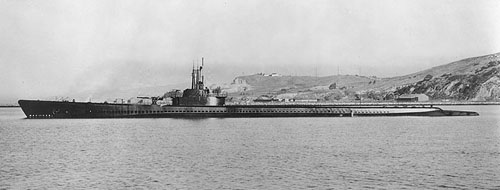
USS_Tang_underway
The United States Navy's fleet submarine USS Tang, underway in Mare Island Sound during her shakedown trials (US Navy photo)

My first book about WW2 was a book about US submarine warfare in the Pacific. Ever since, I've been particularly interested in submarine warfare. And I've accumulated at least as many books about submarine warfare as I have about any other single aspect of WW2. As with my books about land and sea combat, almost all my books about sub warfare divide neatly into three groups: general books about the whole topic, books about the European war, and books about the Pacific war.

General books about the undersea war Subs in the Atlantic and Mediterranean Subs in the Pacific Theater

General books about submarine warfare

I only have one book that really fits this category: a general overview of the entire submarine war.

WAR BENEATH THE SEA
Padfield, Peter
c.1995, John Wiley
ISBN: 0-471-24945-9
Submarine operations in the two theaters were so different that this is the only book I've seen that attempted a single comprehensive look at both. Padfield tries to be thorough, and to a large extent he succeeds. He covers most major incidents from both theaters, including submarine strategy and tactics, the antisubmarine war, and a good overview of the intelligence war behind the scenes, such as Ultra. He also includes a very thorough technical appendix on submarines of the Second World War. Every major type from all four major combatants (Britain, the USA, germany, and Japan) is listed with its technical specifications: dimensions, displacement, armament, speed, and crew complement. However, there are a few weaknesses. In the Atlantic, Padfield focuses on the U-boat war; in the Pacific, he focuses on the American submarine fleet. British subs get rather limited treatment, and Japanese submarines are barely mentioned at all.

Back to top

The Atlantic and Mediterranean Theaters

In the Atlantic and the Mediterranean, the primary submarine war pitted the German U-boat Force against the Allied convoy lines. However, the British waged submarine warfare too, especially in the Mediterranean. I have a few books about both the German and British submarine wars:

BLACK MAY
Gannon, Michael
c. 1998, Dell
ISBN: 0-440-23564-2
In March 1943, Germany's U-boats wrought havoc in the Atlantic convoy lanes, sinking over a hundred ships and losing only a handful of their own number. For a brief time, victory in the Battle of the Atlantic seemed to be within their grasp. But only three months later the U-boat Arm had been shattered: a third of its numbers destroyed, ship sinkings cut by two-thirds, the remaining boats turned from daring surface raiders into desperate fugitives hiding from omnipresent Allied ASW forces. What happened? Black May happened. In Black May, Allied forces sank forty-three U-boats and damaged many more, taking them out of action for months. In BLACK MAY, Michael Gannon does a superb job of telling what happened to so quickly turn the tide against the U-boats in April and May of 1943. Gannon had access to most of the important sources of information for this book, including the archives on Ultra and other sources only declassified in the last few years, after the "fifty years after the war" deadline passed.

THE DEATH OF THE U-BOATS*
Hoyt, Edwin
c.1988, Warner
ISBN: 0-446-35568-2
Edwin Hoyt is a good WW2 historian with a number of good books to his credit. This is his examination of the slow destruction of the German U-boat force by the Allied navies in the Atlantic.

IRON COFFINS
Werner, Herbert
c.1969, Bantam
ISBN: 0-553-23347-5
Herbert Werner served aboard U-boats through most of the war. He started as an ensign aboard U-557 during the "Happy Time" of 1940-41; moved up to Executive Officer aboard U-230 during the Allied counterattacks of 1942 and the devastating slaughter in spring 1943, and made the jump to Commanding Officer of U-415 and then U-953 just in time to be part of the long slow slide toward defeat that only ended with Germany's surrender. His reminiscences form a powerful image of the U-boats' war, how they fought, and what an incredibly stressful existence they led. Werner's experience is typical in every way except one: he lived through it. Most members of the U-boat Arm were not so fortunate.

OPERATION DRUMBEAT
Gannon, Michael
c.1990, Harper Perennial
ISBN: 0-06-092088-2
When the United States entered the war in December 1941, Admiral Doenitz promptly responded by sending a squadron of U-boats to strike at the East Coast shipping lanes. He codenamed this Operation Paukenschlag, which is usually translated to English as "Drumbeat." The next six months was a second "Happy Time" for the U-boats and a nightmare for the US Navy and US merchant shipping, as a force that never numbered more than a dozen U-boats at a time slaughtered hundreds of ships and destroyed some two million tons of priceless supplies.

SUBMARINE COMMANDER*
Bryant, Ben (RAdm RN, Ret.)
c.1958, Bantam
ISBN: 0-553-13665-8
A personal account of submarine warfare, British style. Bryant was one of the Royal Navy's most successful submarine commanders, making successful patrols in both Norwegian and Mediterranean waters. I thought that the most interesting thing about this book was how similar the British tactics were to American and German tactics, and at the same time how very different in some ways. As one example, British subs in the Mediterranean routinely surfaced and attacked enemy ships with gunfire, something that other submariners did rarely if ever.

U-BOAT COMMANDER
Prien, Gunther
c.1969, Award Books
A rarity among personal accounts of the war: this author didn't come back. This book is Guenther Prien's autobiography from the time he joined the German merchant marine, through his training as a U-boat officer, and ending with his daring raid on the British fleet anchorage of Scapa Flow. In that action, Prien's boat, the U-47, torpedoed and sank the British battleship HMS Royal Oak. Prien did not return from his next war patrol; his U-boat was marked as "missing, presumed lost," and the book was published posthumously. The British Admiralty credited HMS Wolverine with sinking Prien's boat. However, later information cast doubt on that credit. Today, it's not known for sure exactly when or how Prien and his boat died.

U-BOAT TANKERS 1941-45
White, John F.
c.1998, Airlife
ISBN: 1-85310-999-1
One of the U-boat Arm's many innovations was the concept of refueling and resupplying U-boats at sea. At first this was done with surface ships, modified merchant tankers and freighters. But after the Allies achieved air superiority over most of the Atlantic, the Germans changed to using submarine tankers -- U-tankers. These were huge submarines that met combat U-boats at remote rendezvous far from land, and resupplied them with food and fuel. Seemingly a brilliant concept, the U-tankers failed in practice, as they died frequently and easily under the bombs and depth-charges of roving Allied hunter-killer battlegroups. This book is the story of the U-tankers, how they lived and operated, and how they all too often died.

U-BOATS OFFSHORE
Hoyt, Edwin P.
c.1978, PEI Books
ISBN: 0-872-16655-4
Another look at Operation Drumbeat, this one by expert military historian Edwin Hoyt. Hoyt focuses largely on the astounding ineptness of the American anti-U-boat defenses, and how the U-boats were able to strike at will while the American Navy deceived itself into thinking it was responding effectively when in fact it wasn't.

Back to top

The Pacific Theater

In the Pacific, the story of the submarine is mainly the story of the US submarine force's war against the Japanese Navy and the Japanese merchant marine. However, the Japanese also had submarines, and while they weren't very effective they did accomplish a few things and had a few books written about them.

BATFISH: The Champion "Submarine-Killer" Submarine of World War II
Lowder, Hughston E.
c.1980, Prentice-Hall
ISBN:
USS Batfish was a US fleet submarine assigned to the Pacific War. Her war career was pretty successful: seven war patrols, claimed 15 ships sunk, officially credited with 9 ships sunk. Like a few of her sisters, Batfish earned fame for a single great accomplishment. In her case, this came on her sixth war patrol, when she torpedoed and sank three Japanese submarines in four days.

CLEAR THE BRIDGE!
O'Kane, Richard H.
c.1977, Presidio
ISBN: 0-89141-346-4
If you only get one book about submarine warfare, then this is the one to get. It's the story of the US Navy's most effective WW2 submarine, USS Tang, as told by her commanding officer Richard O'Kane. Tang was a new breed of deep-diving submarine, capable of safely diving to 600 feet when older subs were limited to 350 feet or so. Tang's technical advances together with her captain's daring brought her to the top of the US submarine success list: 31 sinkings in a career that spanned just five war patrols over only ten months, January through October 1944. I think this is by far the best single book I have about submarine warfare, and one of the best war books I have on any topic. O'Kane is nearly as good a writer as he was a submarine commander, and he was one of the best submarine commanders in the US Navy. A recent hardcover reprint of this book includes a number of wartime photographs. As an interesting supplement, Tang's five war patrol reports are available on the Web.

THE DESTROYER KILLER
Hoyt, Edwin P.
c.1989, Pocket Books
ISBN: 0-671-67183-9
Like O'Kane's Tang, USS Harder ranks among the greatest submarines of the Pacific War. In six war patrols she sank at least twenty ships, and probably more. Even among her sisters, Harder stands out for one phenomenal achievement: her fifth war patrol. In late May and early June of 1944, she was patrolling off the Japanese fleet base of Tawi Tawi in the Philippines. While at Tawi Tawi, Harder sank five Japanese destroyers in four days, causing such a ruckus that the Japanese Fleet set to sea several days early for Operation A-Go, the operation that led to the Battle of the Philippine Sea, otherwise known as the Marianas Turkey Shoot. Sadly, Harder and her sharpshooting commander Sam Dealey did not live to receive the accolades they deserved, as both ship and captain died in action on their sixth war patrol.

HELLCATS OF THE SEA*
Lockwood, Vice Admiral Charles A. (Ret)
c.1955, Bantam
ISBN: 0-553-27059-1
By 1945, the Japanese Empire's only intact shipping lanes were the ones that crossed the almost landlocked Sea of Japan between China and Japan. Pacific Fleet submarine commander Admiral Lockwood was never one to let any chance to attack the enemy go untried, so he organized the "Hellcats," a wolfpack consisting of nine submarines that used new technology to penetrate the minefields that guarded the Sea of Japan's entrances. This is Lockwood's firsthand account of the development of the anti-mine gear, and a description of the damage done by the nine Hellcats.

PIG BOATS
Roscoe, Theodore
c.1958, Bantam
ISBN: 0-553-13040-4
This book has a somewhat confusing history. It was originally published as History of United States Submarine Operations in World War II. Then it was reissued as a mass market paperback in the early 1980s under the title PIG BOATS. This is the version I have. Since then, it's reverted to the original title and is back in print as a trade paperback. In any case, by whatever name it's a very good book. Ted Roscoe was Admiral Lockwood's operations Officer for part of the war, which makes him well qualified to write about submarine operations. This book has a number of flaws, but overall it gives a good thumbnail look at the US Navy's submarine war. It includes detailed looks at submarine operations, the development of many successful tactics, and many specific war patrols and combat actions. It also contains a thorough examination of the hideous problems that US submarines had with their torpedoes.

SHINANO!*
Enright, Joseph
c.1987, St. Martin's Press
ISBN: 0-312-90967-5
The story of how the US submarine Archer-Fish discovered, tracked, and sank the enormous Japanese supercarrier Shinano on her maiden voyage. Shinano was originally intended to be the third Yamato class battleship, but was converted to an aircraft carrier after the Japanese navy's devastating losses at Midway. This book is primarily told from Enright's point of view, but also gives a good look at the Japanese side of the action. Very well done, the book gives a pretty thorough look at the tactics involved in a submarine attack on a small convoy or task force. Note: I have no idea why, but sometime after its original publication, this book was republished under a new title, Sea Assault!

SILENT VICTORY (2 volume set)
Blair, Clay
c.1975, J. B. Lippincott
ISBN:
This is an extremely detailed and complete study of the United States submarine fleet and its fight against the Japanese Navy and merchant marine. In essence this is another attempt at writing a "submarine history of WW2," like Theodore Roscoe's PIG BOATS (see above). However, Blair gets much more detailed than Roscoe and includes much more behind-the-scenes material, such as accounts of the infighting that went on in submarine commands at Pearl Harbor and the Australian bases. A much abridged version of this work was published as a paperback under the title COMBAT PATROL.

SINK 'EM ALL*
Lockwood, Charles (VAdm USN, Ret.)
c.1951, Bantam Books
ISBN: 0-553-23919-8
Charles A. Lockwood spent most of the war as a commander of US submarine forces, first in Australia as Commander Submarines Southwest Pacific (ComSubSoWesPac), then in Pearl Harbor as Commander Submarines Pacific (ComSubPac). This book is his memoir of his war years. "Uncle Charlie" never made a combat patrol, but his no-nonsense attitude combined with his unyielding support of his skippers and crews against both the enemy and the naval bureaucracy became an essential ingredient in the phenomenal success of the American submarine forces.

SUBMARINE!*
Beach, Edward
c.1952, Signet
ISBN:
Ned Beach's classic account of submarine warfare in the Pacific during WW2. Beach entered the Submarine Service as an ensign shortly before Pearl Harbor and served aboard submarines for the entire war. Most of his time was spent aboard ace submarine Trigger. Then he moved to Tirante for her first war patrol, and finally to Piper as her Commanding Officer for a single patrol before the Japanese surrendered. This book contains descriptions of a number of incidents aboard TriggerTirante, and Piper, interspersed with chapters about other top-rank members of the Silent Service: Wahoo, Harder, Seawolf, Tang, and more.

TAKE HER DEEP! A Submarine Against Japan in World War II
Galantin, I. J. (Adm USN Ret)
c.1987, Pocket Books
ISBN: 0-671-73651-5
I. J. "Pete" Galantin commanded the fleet submarine USS Halibut from August 1943 through December 1944. In that time he took part in the solution to the horrible torpedo troubles experienced by the US Submarine Service, and also had quite a lot of success against Japanese shipping despite the failure-prone torpedoes. On Galantin's last patrol, Halibut ran afoul of a new Japanese antisubmarine device, the jikitanchiki or Magnetic Airborne Detector, and was very nearly sunk.

WAHOO
O'Kane, RADM Richard H. (Ret)
c.1987, Bantam
ISBN: 0-553-28161-5
The story of the US submarine Wahoo, as told by Richard O'Kane, who was aboard as Exec for all but her last patrol. In some ways Wahoo could almost be said to typify the American submarining experience during the war. In other ways she was quite unique. Her first two patrols were unsuccessful because her skipper was too cautious. Then she got a new skipper, Dudley "Mush" Morton, and went all the way the other way, from too cautious to foolhardy. She had problems with faulty torpedoes and with effective enemy anti-submarine forces; on the other hand, she also pressed home some extraordinary attacks, and was one of a handful of submarines to operate in the Sea of Japan during the war.

Back to top

Back to Worlds of History