Spy stories have become cliched to the point of comedy in the past few years, while spy organizations like the CIA alternate between being the butt of vicious jokes and the bad guys in wacky conspiracy theories. It's easy to forget that once upon a time, spy stories were not fiction, and covert operations were a deadly serious matter, with many lives riding on the outcome. But such a time really existed. In fact, it's not an exaggeration to say that without covert operations, the Allies might not have won World War 2.
| Codes, ciphers, and cryptanalysis | Covert ops and undercover agents | Using intel on the battlefield |
Codes, Ciphers, and Cryptanalysis
One critical aspect of the covert war was codes and ciphers, and the groups on all sides who worked to break them. Communications is critical in modern warfare. So is the ability to keep those communications secure, so that your side can read them and the other side can't. The correlation is striking: in battle after battle, the side that kept its plans and communications more secure won. The best-known example of this is the Battle of Midway, but there are many other examples as well.
BETWEEN SILK AND CYANIDE: A Codemaker's War 1941-1945
Marks, Leo
c.1998, Free Press
ISBN: 0-684-86422-3
Code-making is the opposite of code-breaking: you try to devise a code good enough that the enemy can't break it. Leo Marks spent much of the war doing exactly that for covert British agents in German-occupied Europe. His story is both interesting and depressing -- interesting because of what he was doing, depressing because even in the middle of the Second World War, his superiors engaged in all kinds of stupid, petty politicking, that made Marks's job harder and probably cost several agents their lives.
CODE BREAKERS: THE INSIDE STORY OF BLETCHLEY PARK
Hinsley and Stripp (eds)
c.1993, Oxford Paperbacks
ISBN: 0-19-285304-X
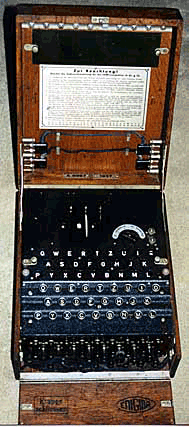
In WW2, the German armed forces used codes and ciphers based on a machine called the Enigma. The Germans believed this system was unbreakable, and by conventional standards it was. The British countered with a massive codebreaking operation based at the country estate called Bletchley Park, which used some very unconventional methods including the first electromechanical computing machines. This book contains a number of essays about Bletchley Park and its work, including technical specifications on the Enigma machine, why it was an effective security device, and how the British cracked it.
COMBINED FLEET DECODED
Prados, John
c.1995, Random House
ISBN: 0-679-43701-0
What the British did to German Enigma, the Americans did to Japan's naval codes. Alone among the major combatants of WW2, the Japanese Navy never used a mechanical cipher system. Instead, they encoded messages using a complicated numeric cipher system that was much easier to break. The American codebreakers were perhaps even more successful against Japanese codes than the British were against Enigma, and it paid huge dividends from the first day of the Pacific War to the last. This book is a thorough and complete history of the American codebreaking effort against Japan.
SEIZING THE ENIGMA: The Race to Break the German U-boat Codes 1939-1943
Kahn, David
c.1991, Houghton Mifflin
ISBN: 0-395-42739-8
A very detailed examination of Bletchley Park's steady and usually successful fight against the ever-more-sophisticated ciphers used by the U-boat Arm.
THE ULTRA SECRET
Winterbotham, F.W.
c.1974, Dell
ISBN: 0-440-19061-4
Details of the Bletchley Park codebreaking operation were only declassified in the mid-1970s. This book was the first of many that delved into the secrets of "Ultra," the codebreaking operation and its effect on Allied strategy and operations in WW2.
Covert Operations and Undercover Agents
These books discuss covert operations of all kinds, from operations in enemy territory to counter-intelligence operations aimed at defending against enemy operations.
ASSAULT IN NORWAY
Gallagher, Thomas
c.1975, Bantam Books
ISBN: 0-553-20248-0
One of the Allies' greatest fears during the war was that Nazi Germany would develop the atomic bomb first. The approach that Germany took to developing an A-bomb depended on a supply of heavy water. The only source for heavy water in German-occupied Europe was a single site in Norway. This book is the story of the commando raid that destroyed the heavy-water factory and crippled the Nazi A-bomb program.
BEYOND TOP SECRET ULTRA
Montagu, Ewen
c.1977, Coward, McCann, & Geogheg
ISBN: 0-698-10882-3
During the Second World War, the British naval intelligence service's Section 17M engaged in a huge operation to feed false information to the German intelligence service, the Abwehr, through double agents and other deceptions. Ewen Montagu worked in Section 17M through most of the war. This book is his first-hand story of how Section 17M operated and what it accomplished.
BODYGUARD OF LIES
Brown, Anthony Cave
c.1975, Harper Collins
ISBN: 0-688-10281-6
"In wartime, truth is so precious that she should always be attended by a bodyguard of lies." So said Winston Churchill in December 1943. The Allies assembled a truly enormous bodyguard of lies to protect the truth of Operation Overlord, the plan to invade Normandy. This book is the story of Plan Bodyguard, also called Operation Fortitude, the widespread and incredibly elaborate plan to feed the Germans false information that would make them look fearfully in every direction except the real one: the beaches of Normandy.
THE DOUBLE CROSS SYSTEM
Masterman, J C
c.1972, Ballantine
ISBN: 0-345-29743-1
An account of Great Britain's wildly successful counter-intelligence operations during WW2. Though even they didn't know it until after the war, the British were able to find and turn every single German agent in England, and use them to feed false information to the German High Command.
FORTITUDE: The D-Day Deception Campaign
Hesketh, Roger
c.2000, St. Ermin's Press
ISBN: 1-58567-075-8
Another detailed investigation of Operation Fortitude, the enormous, elaborate deception used to keep the Germans from learning the true time and place of the invasion of Europe.
THE MAN WHO NEVER WAS
Montagu, Ewen
c.1953, Bantam
ISBN:
In spring 1943, British intelligence agent Ewen Montagu conceived a daring and complex plan to feed false information to the German General Staff, in order to help cover the invasion of Sicily (Operation Husky). The plan involved using a fictional British army officer to let German agents capture letters containing what seemed to be top-secret details on upcoming Allied operations. It was codenamed Operation Mincemeat, and it was so successful that the Germans never realized the whole thing had been a set-up, even long after the invasion of Sicily took place. This book seems to be long out of print, which is a pity because it's an amazing story.
THE OSS IN WORLD WAR II
Hymoff, Edward
c.1972, Ballantine Books
ISBN: 345-22882-0-165
A history of the Office of Special Services in World War II. The OSS was the forerunner of the Central Intelligence Agency, and its agents were involved in numerous covert operations within German-held territory.
OSS SPECIAL WEAPONS & EQUIPMENT - Spy Devices of WWII
Melton, H. Keith
c.1991, Sterling Publishing
ISBN: 0-8069-8239-X
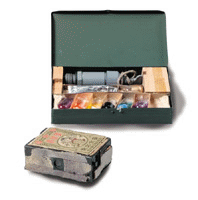
This is a collection of weapons and devices that were available to OSS field agents during the War. Some are conventional: fighting knives, small pocket pistols, a spring-loaded expanding billy club. Some are well-known saboteur's tools: bombs and time-fuses of many kinds. Some are odd: a silenced M3 submachine gun, a chemical for disabling car and truck engines, a single-shot gun fitted to the back of a glove. Some are right out of James Bond: single-shot guns disguised as cigarettes and pens, collapsible crossbows, dart guns, one-man submarines. A fun book to leaf through for anyone interested in military gadgets.
SAS WITH THE MAQUIS: In Action with the French Resistance June-Sept 1944
Wellsted, Ian
c.1997, Greenhill Books
ISBN: 1-85367-285-8
STRATEGIC DECEPTION IN THE SECOND WORLD WAR
Howard, Michael
c.1990, W. W. Norton
ISBN: 0-393-31293-3
A general look at the tactics and techniques used by the British during WW2 in their ongoing attempts to deceive the German High Command as to the direction of Allied strategy.
TROJAN HORSES: Deception Operations in the Second World War
Martin Young & Robbie Stamp
c.1989, Mandarin Books
ISBN: 0-7493-0603-3
A collection of short studies of various deception operations during the War, and the men and women who carried them out. Dummy tanks, fake army units, false radio messages, sabotage -- the whole gamut of deception operations is covered.
THE WAR MAGICIAN
Fisher, David
c. 1983, Coward McCann, Inc.
ISBN: 0-698-11140-0
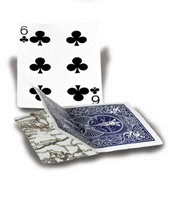
When World War 2 started, Jasper Maskelyne was a thirty-eight-year-old stage magician, famous throughout England. In 1940 he joined the British Army and was posted to North Africa. There, he put his unique talents to work for the British cause, elevating camouflage from a rather casual art to a major weapon in the war against the Axis. Maskelyne and his group accomplished a number of things that are almost literally unbelievable. He made the Suez Canal disappear. He "moved" Alexandria Harbor. He helped create a phantom army before the battle of El Alamein, and to hide the real army from German reconnaissance. . His actions during the war make for one of the strangest and most amazing WW2 stories I know.
YOU CAN'T FIGHT TANKS WITH BAYONETS: Psychological Warfare against the Japanese Army in the South Pacific
Gilmore, Allison B.
c.1998, Univ of Nebraska Press
ISBN: 0-965-059866
An account of some of the psychological-warfare and propaganda techniques used by Allied psy-ops units against the Japanese in the Southwest Pacific Theater.
Intelligence on the Battlefield
These books looks at the operational aspects of intelligence and covert operations: how they were used on the battlefield to help defeat the enemy and change the course of the war. Some battles literally could not have been won without accurate intelligence; others would have been far longer and more costly.
ULTRA AT SEA
Winton, John
Even the best intelligence information is of little help if field commanders don't use it. In this book, Winton talks about how the Royal Navy used the information it received from Bletchley Park's codebreakers and the Admiralty's Operational Intelligence Centre.
VERY SPECIAL INTELLIGENCE*
Beesly, Patrick
c.1977, Ballantine
ISBN: 0-345-29798-9
The story of the Royal Navy's Operational Intelligence Centre during WW2. The O.I.C. was in charge of taking intelligence from all sources and coordinating it for the Admiralty. In the process of describing O.I.C.'s war, Beesly gives a very nice overview of the entire war at sea as seen by the Royal Navy's strategists and planners. Much of O.I.C.'s intelligence material came from "Ultra," the Bletchley Park codebreakers, but this book is not about codebreaking directly. It's about how the intelligence material was used.