Military History:
World War II on Land

Soldiers, Sailors, and Airmen
of the Allied Expeditionary Force!

You are about to embark upon the Great Crusade, toward which you have striven these many months. The eyes of the world are upon you. The hopes and prayers of liberty-loving people everywhere march with you. In company with our brave Allies and brothers-in-arms on other Fronts, you will bring about the destruction of the German war machine, the elimination of Nazi tyranny over the oppressed peoples of Europe, and security for ourselves in a free world.

-- from General Dwight Eisenhower's notice to his troops before the invasion of Normandy, June 1944
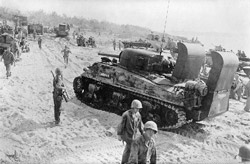
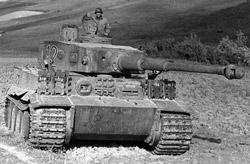
Sherman tank and troops on the beach at Tinian island, 1944 Captured Tiger I tank in Tunis, 1943

The main part of World War II was fought on land -- Europe and Africa in the European Theater, and various islands in the Pacific Theater. For some reason my interest in land warfare tends to focus on a few specific aspects such as armored warfare and the island fighting in the Pacific, so I tend to have many books about those aspects and very few books about other aspects.

As with my sea-warfare and air-warfare books, these have been split by theater:

The European Theater:

North Africa and the Mediterranean Fighting on the Western Front Fighting on the Eastern Front Personal Accounts & Combat Journals

The Pacific Theater:

The Guadalcanal Campaign Island-hopping in the Central Pacific Jungle fighting in the Southwest Pacific Personal Accounts & Combat Journals

Europe: The North Africa and Mediterranean campaigns

The North Africa campaign was a strange one. It didn't threaten critical areas for either side, except the Suez Canal for Great Britain. It started as a meaningless land grab by Italy, and became the prime showcase and proving-ground for the new styles of mechanized warfare. It also was a testing ground for many other aspects of the new warfare: camouflage, deception, and so on. For almost two years it was the only place in the whole European theater where Allied and Axis land armies fought on a large scale. For all these reasons, I think it's worth a close look.

BRAZEN CHARIOTS*
Crisp, Robert
c.1959, Bantam Books
ISBN: 0-553-11812-9
A rare and exceptionally well written look at armored warfare, WW2 style. Major Robert Crisp was an officer in the British Eighth Army, which fought the Italians and Germans in the deserts of North Africa.

THE CAMPAIGN FOR NORTH AFRICA*
Coggins, Jack
c.1980, Doubleday & Co.
ISBN: 0-385-04351-1
An analytical look at the entire North Africa campaign: strategy, tactics, weapons, plans, and operations. Coggins includes a number of diagrams and statistics on individual weapons, the kind of data that many authors don't bother to include.

STIRLING'S DESERT RAIDERS*
Cowles, Virginia
c.1958, Bantam
ISBN: 0-553-24882-0
This tells the story of Stirling's long-range desert raiders, an elite commando unit that wrought havoc behind the German lines in North Africa.

Back to top

Europe: The Normandy invasion and the Western Front

Eisenhower called it "the Great Crusade." Military planners called it "Operation Overlord." It began the battle against Germany on the Western Front, and the liberation of France and Western Europe. Over the next ten months the Americans, British, and Canadians slowly and systematically annihilated the German forces facing them, dealt the German Army its single biggest defeat of the war, and enormously accelerated Germany's collapse and defeat.

THE LONGEST DAY
Ryan, Cornelius
c.1987, Touchstone
ISBN: 0-671-89155-3
Cornelius Ryan is to the European War what Walter Lord is to the Pacific War. Ryan's books cover some of the most critical operations of the European war in close detail. THE LONGEST DAY is Ryan's study of the invasion of Normandy, June 6th, 1944. This book is a classic in every sense of the word. Every later study of D-day refers to it. No serious student of WW2 should be without it.

OVERLORD: D DAY & THE BATTLE FOR NORMANDY*
Hastings, Max
c.1984, Touchstone
ISBN: 0-671-55435-2
A detailed account of the planning and execution of Operation Overlord, written with forty years of hindsight and a great deal of recently released secret data. Hastings is pretty fair in his evaluation of both sides, what they did right and also what they did wrong.

D DAY
Ambrose, Stephen
A detailed account of the Normandy invasion, told primarily from the viewpoint of the regular soldiers in the American Army. Ambrose covers all of the invasion operation and the landings themselves, up to nightfall on June 6th, 1944.

BATTLE OF THE BULGE*
Merriam, Robert E.
c.1947, Ballantine
ISBN: 0-345-31104-3
An account of the Battle of the Bulge. This one focuses on strategic and high-level tactical aspects; there's little on the local unit level.

CITIZEN SOLDIERS
Ambrose, Stephen
c.1997, Simon & Schuster
ISBN: 0-684-84801-5
Sequel to Ambrose's D DAY, this book follows the American Army's role on the Western Front from the day after D-Day through the battles of Normandy, Falaise, and the Bulge, all the way to the conquest of Germany and the end of the war.

COMPANY COMMANDER
MacDonald, Charles
c.1947, Bantam Books
ISBN: 0-553-12141-3
Charles MacDonald was a captain in the 23rd Infantry Regiment, 2nd Infantry Division, on the Western Front in late 1944 and 1945. He commanded Company I of the 23rd during December 1944 and took the full brunt of the German assault in the opening phases of the Battle of the Bulge. After being wounded and spending time in hospital, he returned to action as commander of Company G of the 23rd during the final invasion of Germany in March and April 1945.

FOUR STARS OF HELL*
Critchell, Laurence
c.1947, Ballantine
ISBN:
The story of General Ridgway, commander of the 82nd Airborne Division which made several combat drops on the Western Front.

HERE IS YOUR WAR
Pyle, Ernie
c.1943, Henry Holt
ISBN:
Ernie Pyle was a famous war correspondent whose columns from the front brought the war home to millions of Americans in civilian life. This is a collection of some of his best columns. Sadly, Pyle did not survive the war. He was killed in April 1945 while covering the US Marines' invasion of a minor island called Ie Shima, near Okinawa.

ONE MORE HILL
Johnson, Franklyn
c.1949, Bantam
ISBN: 0-553-26728-0
The story of the US Army's First Infantry Division, the "Big Red One," in World War 2, from North Africa to Normandy.

SEE HERE, PRIVATE HARGROVE
Hargrove, Marion
c.1942, Henry Holt
ISBN:
A humorous look at boot camp and life as a private in the US Army.

Back to top

Europe: The Eastern Front

Some people think that Russia could have defeated Nazi Germany without any help from the Western Allies. That's a drastic exaggeration, but it's no exaggeration to say that the Eastern Front involved much larger armies fighting over far greater areas than the Western Front did, and that the assault on Russia made the difference between Germany's victory and her total defeat.

199 DAYS: THE BATTLE FOR STALINGRAD
Hoyt, Edwin P.
c.1993, Forge Books
ISBN: 0-312-86853-7

FIGHTING IN HELL: The German Ordeal on the Eastern Front
Tsouras, Peter G. (Ed.)
c.1995, Ballantine/Ivy
ISBN: 0-8041-1698-9

THE SECRET OF STALINGRAD
Kerr, Walter
c.1978, Doubleday & Co.
ISBN: 0-872-16569-8

THE TIGERS ARE BURNING
Caidin, Martin
c.1974, Pinnacle
ISBN: 0-523-41816-7
An account of the Battle of Kursk, on the Russian Front in summer 1943. Kursk was the largest tank battle of the war, involving huge numbers of tanks on both sides.

Back to top

Europe: Personal accounts

"Personals" are what I call first-person accounts of military service -- usually combat, but sometimes other types of military service. These are personals from the European Theater of Operations.

Donald Burgett joined the US Army in 1943 and trained as a paratrooper. He was then assigned to the 101st Airborne Division, the famed "Screaming Eagles," and fought in all four of the 101st's major operations in Europe: the D-day invasion, the disastrous Operation Market-Garden, the desperate defense of Bastogne during the Battle of the Bulge, and the final invasion of Germany. He was wounded three times and won a Bronze Star for valor. In 1967 he wrote a book about the Normandy invasion. In the last few years he followed up with three more books, done from memory, of the other three operations. All four are part of Dell's current series of books about WW2:

CURRAHEE! A Screaming Eagle at Normandy
c.1967, Dell
ISBN: 0-440-23630-4
The 101st Airborne Division was one of three airborne divisions that was dropped over Normandy as the first stage of Operation Overlord, on June 6th, 1944. This book describes Burgett's training as a paratrooper and his combat experiences in Normandy.

THE ROAD TO ARNHEM: A Screaming Eagle in Holland
c. 2001, Dell
ISBN: 0-440-23633-9
In September 1944, British Field Marshal Bernard Montgomery launched a daring plan to end the war in one swift stroke: Operation Market-Garden. Three separate airborne attacks would seize a long stretch of road from Eindhoven to Arnhem, including several major bridges. Then an armored attack would break through to Eindhoven and drive on to Arnhem, breaching the Rhine River and breaking Germany's greatest defensive line. Don Burgett's 506th Parachute Infantry Regiment was tasked to take the town of Zon, the next major town north of Eindhoven. This book is his account of the parachute drop into Holland and the weeks of grueling combat that followed.

SEVEN ROADS TO HELL: A Screaming Eagle at Bastogne
c.1999, Dell
ISBN: 0-440-23627-4
On December 16th, 1944, Hitler launched his last great counterattack on the Western Front: Operation Wacht am Rhein, which began the Battle of the Bulge. The 101st Airborne was on rest status in north-central France, far behind the lines, rebuilding from its heavy losses during Operation Market-Garden. When the Germans broke the line in the Ardennes, the 101st was ordered into action. For the next two weeks, the 101st Airborne together with a handful of other units held the surrounded city of Bastogne against repeated German assaults. This book is Burgett's first-hand account of the savage, bitter fighting around Bastogne.

BEYOND THE RHINE: A Screaming Eagle in Germany
c.2001, Dell
ISBN: 0-440-23636-3
This is Burgett's account of his experiences during the last months of the war against Germany, from the German offensive codenamed "Nordwind" in January 1945 through V-E day.


Other personals from the ETO:

BRAZEN CHARIOTS
Crisp, Robert
c.1959, Bantam Books
ISBN: 0-553-11812-9
A rare and exceptionally well written look at armored warfare, WW2 style. Major Robert Crisp was an officer in the British Eighth Army, which fought the Italians and Germans in the deserts of North Africa.

COMPANY COMMANDER
MacDonald, Charles
c.1947, Bantam Books
ISBN: 0-553-12141-3
Charles MacDonald was a captain in the 23rd Infantry Regiment, 2nd Infantry Division, on the Western Front in late 1944 and 1945. He commanded Company I of the 23rd during December 1944. His unit took the full brunt of the German assault in the opening phases of the Battle of the Bulge. After being wounded and spending time in hospital, he returned to action as commander of Company G of the 23rd during the final invasion of Germany in March and April 1945.

SOLDAT
Knappe, Siegfried
c.1992, Dell
ISBN: 0-440-21526-9
Siegfried Knappe joined the German Army in 1936 and saw combat on both the Eastern and Western fronts, then spent five years in a Russian prison. This book tells his story, based on his wartime journals and his memories.

TO HELL AND BACK
Murphy, Audie
c.1949, Bantam
ISBN: 0-553-23206-1
Audie Murphy's famous combat journal, detailing his experiences as an infantryman in the US Army during WW2. Murphy participated in the Sicily, Southern Italy, Anzio, and Southern France campaigns, and became the most decorated US Army soldier of the war. For his valor on the battlefield, Murphy won every decoration the US Army could give, up to and including the Congressional Medal of Honor.

Back to top

The Pacific War: The Guadalcanal Campaign

The Battle for Guadalcanal was the pivotal battle of the Second World War in the Pacific. It lasted six months and featured many battles between the best troops and ships that both sides had to offer. When it was over, the Japanese advance had been ended forever, and the course of the rest of the war was firmly set.

THE BATTLE FOR GUADALCANAL
Griffith, Samuel B.
c.1963, Bantam
ISBN: 0-553-20472-6
Samuel Griffith participated in the Guadalcanal Campaign as an officer in the First Raider Battalion, First Marine Division. After the war he wrote this detailed account of the Guadalcanal Campaign from initial strategy to final battle, based on both official records and personal recollection. Griffith vividly captures the whole long, bitter, bloody struggle for Guadalcanal: six months of tropical hell for both sides, with Japanese and American air, sea, and land forces engaging in a series of battles that left both sides drained almost beyond recovery.

BLOODY RIDGE: The Battle that Saved Guadalcanal
Smith, Michael S.
c.2000, Pocket Books
ISBN: 0-7434-6321-8
"Bloody Ridge" or "Edson's Ridge" is the name given to the battle that took place on Guadalcanal on September 13-15, 1942, between Mike Edson's battalion of Marines and some five times as many Japanese Army soldiers. It was the first of two hard-fought battles that made the difference between defeat and victory for the Americans on Guadalcanal.

THE CAMPAIGN FOR GUADALCANAL
Coggins, Jack
c.1974, Doubleday & Co.
ISBN: 0-385-04354-6
This is more or less a strategist's guide to the Battle of Guadalcanal. Coggins documents the major actions of the battle with good maps and accompanying descriptions, and also gives drawings and basic information on many of the weapons used in the battle.

CHALLENGE FOR THE PACIFIC: The Bloody Six-Month Battle of Guadalcanal
Leckie, Robert
c.1999, Da Capo Press
ISBN: 0-306-80911-7

GUADALCANAL: STARVATION ISLAND
Hammel, Eric
c.1987, Pacifica Press
ISBN: 0-935553-04-5
In 1987-89 Eric Hammel published a series of three books about the Battle of Guadalcanal. This one describes the land battles on the island in graphic detail. It draws its name from the bitterly ironic fact that the Japanese codename for Guadalcanal was "KA," a homonym for the Japanese kanji that means "hunger." Both sides had trouble supplying their troops with food, fuel, and ammunition, but for the Japanese the supply problems were so bad that more of them died from hunger and disease than from Allied bombs and bullets.

GUADALCANAL: THE FIRST OFFENSIVE
Miller, John Jr.
c.1995, Barnes & Noble Books
ISBN: 1-56619-982-4
This is the US Army's official volume on the Army's role in the Battle of Guadalcanal, published as part of the Army's official history of its combat operations in World War II.

GUADALCANAL: The Definitive Account of the Landmark Battle
Frank, Richard B.
c.1990, Penguin Books
ISBN: 0-14-016561-4
A long, detailed, thorough, extremely good account of all facets of the Battle of Guadalcanal, from initial strategy to the final offensive. Very, very good, although in some ways it lacks the immediacy of other books about the Guadalcanal Campaign.

Back to top

The Pacific War: The Central Pacific Campaign

Though the Pacific War was fought over thousands of miles of ocean, "land warfare" is still the best category I can find for books that focus on land fighting, even island fighting. These books are about the Central Pacific campaign, featuring the United States Pacific Fleet and the Marine Corps taking a series of coral atolls and islands from ever stronger Japanese garrisons. Please note that I've arranged these books by time and campaign rather than alphabetically, because that seemed a more appropriate way to do it.

STORM OVER THE GILBERTS
Hoyt, Edwin
c. 1978, Mason-Charter
ISBN:
An account of Operation Galvanic, the occupation of the Gilbert Islands by Marine forces in November 1943. The Gilberts were the first of several Central Pacific operations, and proved a foretaste of what was to come. The invasion of Tarawa atoll became the worst and bloodiest battle the Marines had faced to date, because no one expected the scale of the Japanese defenses.

TO THE MARIANAS
Hoyt, Edwin
c. 1980, Litton Educational
ISBN:
Hoyt's account of the invasions of the Marshalls and Marianas, the two major Central Pacific operations of early and mid 1944.

LIBERATION OF GUAM, THE
Gailey, Harry
c.1988, Presido Press
ISBN: 0-89141-651-X
A description of the invasion and liberation of Guam in July 1944.

IWO JIMA
Newcomb, Richard F.
c.1965, Bantam Books
ISBN: 0-553-22622-3
The Battle of Iwo Jima in February and March 1945 was the worst single battle in the entire history of the United States Marine Corps. Iwo Jima is mostly volcanic rock, and the Japanese garrison had fortified it as well as they possibly could. This book is perhaps the best single account I've read of this battle.

IWO JIMA: LEGACY OF VALOR
Ross, Bill
c.1986, Vintage Books
ISBN: 0-394-74288-5
Another book about the Battle of Iwo Jima.

IWO JIMA*
Newcomb, Richard F.
c.1965, Bantam
ISBN: 0-553-22622-3
A detailed day-by-day account of the Battle of Iwo Jima. Iwo was one of the worst campaigns of the whole Pacific War: fifteen thousand Marines set against twenty thousand Japanese defenders, fighting over an island that was almost made to order for defensive tactics and strategy.

OPERATION ICEBERG
Astor, Gerald
c.1995, Dell
ISBN: 0-440-22178-1
Operation Iceberg was the codename for the invasion of Okinawa island. This book is a look at the Okinawa invasion through the eyes of the soldiers, sailors, airmen, and marines who fought there.

Back to top

The Pacific War: The Southwest Pacific Campaign

The Southwest Pacific campaign involved amphibious invasions of large islands where major army engagements were quite workable. This made it a sort of cross between European-style large-scale ground warfare and Central Pacific "island hopping" amphibious warfare. It was also some of the nastiest fighting of the entire Pacific war.

TOUCHED WITH FIRE: The Land War in the South Pacific
Bergerud, Eric
c.1996, Penguin Books
ISBN: 0-14-024696-7
A general overview of the entire South and Southwest Pacific land war.

RAIDER BATTALION*
Hoyt, Edwin
c.1980, Pinnacle
ISBN: 0-523-40670-3
A description of the Marine "Raider Battalions" used extensively in the first year or so of the Pacific War.

GLORY OF THE SOLOMONS*
Hoyt, Edwin
c.1983, Stein and Day
ISBN: 0-8128-2895-X
A detailed examination of the Central Solomons campaign of summer and fall 1943, code-named Operation Watchtower. As a general historian, Hoyt does an excellent job of covering both the naval and the land-combat aspects of the Solomons campaign.

MUNDA TRAIL
Hammel, Eric
c.1989, Avon
ISBN: 0-380-71458-2
Munda was one of the islands in the Solomons chain that American troops had to take, in order to neutralize a Japanese airfield there.

THE BATTLE FOR MANILA
Connaughton, Pimlott, Anderson
c.1995, Presidio Press
ISBN: 0-89141-771-0
An account of the Battle of Manila in 1945, in which invading American and Filipino forces liberated the Philippines capital city from the Japanese.

CRISIS IN THE PACIFIC
Astor, Gerald
c.1996, Dell
ISBN: 0-440-23695-9
Eyewitness accounts from men who took part in the liberation of the Philippines, from October 1944 through the end of the Pacific War.

The Pacific: Personal Accounts

These are personal accounts from the land wars against Japan.

AMERICAN GUERILLA IN THE PHILIPPINES
Wolfert, Ira
c.1945, Bantam Books
ISBN: 0-553-13806-5
Iliff David Richardson went to the Philippines in 1941 as a sailor aboard the minesweeper USS Bittern. Then he transferred to MTB Squadron 3, John Bulkeley's PT-boat unit. When the Japanese invaded the Philippines, MTB-3 fought against them until every one of the unit's boats had been sunk. When the boats were all gone, Richardson took to the hills and became a guerilla, working with Filipino resistance groups against the Japanese occupation. This is his story, exactly as he told it to Ira Wolfert. Wolfert is listed as the author, but it's Richardson's story.

DEFEAT INTO VICTORY: Battling Japan in Burma and India, 1942-1945
Slim, Viscount William
c.1972, Cooper Square Press
ISBN: 0-8154-1022-0
Viscount Slim was the commander of the British army in the Burma-India theater during most of WW2. This is his personal account of the war waged in that theater, grim and bloody jungle fighting which has been largely ignored by most histories of the War.

A HELMET FOR MY PILLOW
Leckie, Robert
c.1957, Bantam Books
ISBN: 0-553-28265-4
I have only a couple of personals by men who can honestly claim they fought in some of the war's critical battles. This is one of them. Robert "Lucky" Leckie enlisted in the US Marine Corps in January 1942. After going through boot camp he was assigned to the First Marine Regiment and was part of the force that landed on Guadalcanal on August 7th, 1942. He fought through most of the Guadalcanal Campaign, leaving only when the entire First Marine Division was pulled off the island in December 1942. After that, he fought in two other campaigns: New Guinea and Peleliu. On Peleliu he was seriously wounded and never saw combat again.

MARINE AT WAR
Davis, Russell
c.1961, Scholastic Books
Russell Davis joined the Marines in 1944 and saw combat in two of the Marines' bloodiest battles: Peleliu and Okinawa.

Back to top

Back to Worlds of History