Earthquakes, Volcanoes,
and Plate Tectonics
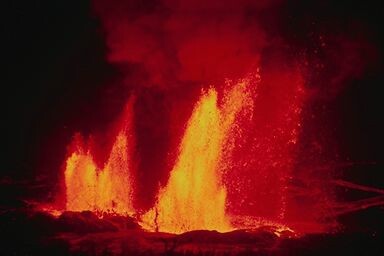
Lava fountain volcanic eruption

Earthquakes and volcanoes are interesting in their own right, as manifestations of the power of nature at its greatest. The scale of major earthquakes and volcanic eruptions can simply boggle the mind. And beyond that, both are aspects of plate tectonics, the grand unifying theory of geology and the process that has shaped our planet's surface over its entire history.

Volcanoes Earthquakes Both subjects Plate tectonics

Volcanoes

Volcanoes are among the most powerful and destructive natural disasters Earth has to offer. They also relate intimately to the question of Earth's interior and the geologic processes that drive the planet's internal cycles. I have a number of books about them; some about specific volcanoes, others about volcanoes in general.

FIRE MOUNTAINS OF THE WEST: THE CASCADE AND MONO LAKE VOLCANOES
Harris, Stephen L.
c.1988, Mountain Press
ISBN: 0-87842-220-X
A combination of long-lived tectonic activity and large cities mean that the West Coast of North America hosts some of the most potentially dangerous volcanoes in the world. The Cascades range includes Mount St. Helens, Mt. Rainier, Mt. Hood, Mt. Shasta, and several other well known volcanoes. Several of them are considered active or potentially active right now, and pose major risks to humans. Mono Lake is a region in southern California that is also considered at high risk for major volcanic activity.

KRAKATAU: The Destruction and Reassembly of an Island Ecosystem
Thornton, Ian
c.1996, Harvard Univ. Press
ISBN: 0-674-50572-7
Prior to the year 1883, the Sunda Strait between Sumatra and Java contained an island called Krakatoa. That island was one giant volcano. In 1883, the Krakatoa volcano exploded with tremendous force -- possibly the most powerful explosion in recorded history, it destroyed the island and killed thousands of people on neighboring islands. In the years that followed, a couple of new, small islands formed on the edges of the Krakatoa caldera. This book studies the destruction of Krakatoa and the return of life to the small islands that replaced it.

MELTING THE EARTH: The History of Ideas on Volcanic Eruptions
Sigurdsson, Haraldur
c.1999, Oxford Univ. Press
ISBN: 0-19-510665-2

MOUNT ST. HELENS: THE ERUPTION & RECOVERY OF A VOLCANO
Carson, Rob
c.2000, Sasquatch Books
ISBN: 1-57061-248-X
Mount St. Helens in northern Oregon is the most recently active volcano in North America. This is a detailed account of St. Helens's 1979-81 eruption cycle, and of the ways the devastated region recovered after the blast eruption of 1980. It's very interesting to compare this book, written with twenty years of observations behind it, to VOLCANO: THE ERUPTION OF MT. ST. HELENS (see below), and see what the earlier book got right and wrong. A great many predictions about how the area would or wouldn't recover turned out quite wrong.

OUT OF THE CRATER: Chronicles of a Volcanologist
Fisher, Richard V.
c.1999, Princeton Univ Press
ISBN: 0-691-07017-2

PLANET EARTH: VOLCANO
various
c.1982, Time-Life Books
ISBN: 0-8094-4304-X
One of the Time-Life Books "Planet Earth" series. Like the other books in this series, this one has lots of pictures and not much text, and focuses on how volcanoes have affected humans.

VOLCANO COWBOYS: The Rocky Evolution of a Dangerous Science
Thompson, Dick
c.2000, St. Martin's Press
ISBN: 0-312-20881-2
Volcanology is one of the most dangerous fields of science, because it involves close-up and personal encounters with active volcanoes and volcanic phenomena. As a result, it tends to attract a unique sort of person, equal parts scientist and adventurer. This book is a look at the "cowboys" who have built volcanology into a valid branch of the earth sciences.

VOLCANO: THE ERUPTION OF MOUNT ST. HELENS
Various
c.1980, Longview Publishers
ISBN: 0-914842-54-4
A look at the eruption of Mount Saint Helens, written shortly after the May 1980 explosion. It's interesting to look back on this book with twenty years of hindsight, and see what it got right and wrong.

VOLCANOES
Decker, Robert & Barbara
c.1998, WH Freeman & Co.
ISBN: 0-7167-2440-5
A sort of "non-textbook" about volcanoes and volcanology. That is, it has the depth and detail of a textbook, but it's written to a nonscientist's level, rather than a college student's level. There's some very good information in this book, and it's about as up to date as a book can be. It gets revised every three or four years -- this is the 3rd edition.

Back to top

Earthquakes

Earthquakes are the second main class of natural disaster which comes from below the earth, rather than the surface (like wildfires) or the sky (like storms). Over the centuries earthquakes have probably done more damage and killed more people than volcanoes have, despite the fact that they are somewhat less powerful. Like volcanoes, earthquakes are driven by long-lasting geologic processes that are not always well understood. I have several books that focus on earthquakes.

EARTHQUAKES
Bolt, Bruce A.
c.1988, W. H. Freeman
ISBN: 0-7167-1874-X
A basic guide to earthquakes: what they are, why they happen, what happens in an earthquake, earthquake zones, etc.

EARTHQUAKES AND GEOLOGICAL DISCOVERY
Bolt, Bruce A.
c.1993, W. H. Freeman
ISBN: 0-7167-5040-6
Written for SCIENTIFIC AMERICAN magazine, this book is an explanation of earthquakes combined with a description of what the study of earthquakes (seismology) has taught us about Earth, its surface, and its interior.

MAGNITUDE 8: Earthquakes and Life Along the San Andreas Fault
Fradkin, Philip L.
c.1999, Univ. of California Press
ISBN: 0-520-22119-2

THE NEW MADRID EARTHQUAKES
Penick, James Lal, Jr.
c.1981, Univ of Missouri Press
ISBN: 0-8262-0344-2
A detailed look at the New Madrid earthquakes of 1812-13, the three most powerful quakes ever recorded in the continental United States.

PEACE OF MIND IN EARTHQUAKE COUNTRY
Yanev, Peter I.
c.1991, Chronicle Books
ISBN: 0-87701-771-9
A somewhat different kind of book about earthquakes. Peter Yanev is a structural engineer who specializes in designing and building earthquake-resistant buildings. His goal in writing this book was to educate California homeowners on how to make their homes more earthquake-resistant and how to minimize and deal with damage from a major earthquake. In the process, he does an excellent job of describing the hazards that earthquakes pose to modern buildings and lifestyles.

PLANET EARTH: EARTHQUAKE*
Walker, Bryce
c.1982, Time-Life Books
ISBN: 0-8094-4300-7
One of the Time-Life Books "Planet Earth" series. Like the other books in this series, this one has lots of pictures and not much text, and focuses on how earthquakes have affected humans.

Back to top

Earthquakes and volcanoes both

Because earthquakes and volcanoes are so closely related, there are some books that discuss both. I have a couple of these:

THE EARTH IN TURMOIL: Earthquakes, Volcanoes, and Their Impact on Humankind
Kerry Sieh & Simon LeVay
c.1998, WH Freeman & Co.
ISBN: 0-7167-3651-9
A wonderful, clear, well-written book about earthquakes, volcanoes, and their effects on people.

EARTHQUAKES AND VOLCANOES: Readings from Scientific American
Various
c.1980, WH Freeman & Co.
ISBN: 0-7167-1164-8
A collection of articles from the magazine Scientific American about earthquakes and volcanoes. These articles all date from the time when Scientific American considered itself a formal journal, not a popular magazine. These articles are as solid and scientific asanything from a journal would be.

WHY THE EARTH QUAKES: The Story of Earthquakes and Volcanoes
Matthys Levy & Mario Salvadori
c.1995, W. W. Norton
ISBN: 0-393-03774-6

Back to top

Plate Tectonics

Plate tectonics is the grand unifying theory of geology, just as relativity is the grand unifying theory of physics and evolution is the grand unifying theory of biology. Nothing in modern geology makes sense without plate-tectonics theory; with the theory, everything in geology slides into a unified whole. The theory touches nearly every aspect of Earth's history. You simply can't understand prehistoric life or modern geology without some understanding of plate tectonics. It's that important. And further, the story of how the theory was developed is one of the great stories of modern science. For both reasons, I have several books specifically about plate tectonics:

200,000,000 YEARS BENEATH THE SEA*
Briggs, Peter
c.1971, Holt, Rinehart & Winston
ISBN: 0-03-085983-2
The story of the voyages of the research vessel Glomar Challenger during the 1960s. During more than ten years of voyages, Glomar Challenger made detailed surveys of the ocean floor and took hundreds of cores of deep-sea sediments at sites all over the world. The data from Glomar Challenger's surveys were one of several lines of evidence that came together in the 1960s and 1970s to form the basis for the modern theory of plate tectonics.

CHALLENGER AT SEA: A SHIP THAT REVOLUTIONIZED EARTH SCIENCE
Hsu, Kenneth J.
c.1992, Princeton Univ.
ISBN: 0-691-08735-0
Kenneth Hsu was a scientist on board the Glomar Challenger during many of her voyages. This is his firsthand account of the ship, her crew, and her work.

CONTINENTS ADRIFT AND CONTINENTS AGROUND*
Various
c.1976, W. H. Freeman
ISBN: 0-7167-0280-0
A collection of articles from Scientific American magazine documenting the development of the theory of plate tectonics from 1963 to 1976. Some of the same articles are also available in an older collection called CONTINENTS ADRIFT, but I'm listing only the later one. Many of these articles are especially interesting because they date from a time when Scientific American was a true science journal, and published journal-quality articles with all the trimmings: the formal language, the carefully-worked-out arguments, the supporting illustrations and references.

THE ORIGIN OF CONTINENTS AND OCEANS
Wegener, Alfred
c.1966, Dover Books
ISBN:
Alfred Wegener first devised the theory of continental drift in the 1930s, but his theory failed to catch on because of several big problems with it. This book is an English translation of the 4th edition of Wegener's ENTSTEHUNG DER KONTINENTE. It's an interesting read because it shows clearly how very, very close Wegener did come to getting it all correct.

PLANET EARTH: CONTINENTS IN COLLISION*
Miller, Russell
c.1983, Time-Life Books
ISBN: 0-8094-4324-4
Another in the Time-Life "Planet Earth" series. This one is probably the best explanation of the modern theory of plate tectonics that I've seen outside a college geology textbook.

THE RESTLESS EARTH: A REPORT ON THE NEW GEOLOGY*
Calder, Nigel
c.1972, Viking Press
ISBN: 0-670-59530-6
A look at the theory of plate tectonics, published in 1972 when it was still new.

SHAPING THE EARTH: TECTONICS OF CONTINENTS AND OCEANS
Moores, Eldridge M.
c.1990, W. H. Freeman
ISBN: 0-7167-2141-4
A collection of recent articles from SCIENTIFIC AMERICAN about geology and plate tectonics.

Back to top

Back to Geology page