The fourth day, Friday, we first went to Stirling Castle, above the town of the same name. Stirling Castle is an incredible, magnificent sight: a huge castle perched atop a five hundred foot high outcrop of volcanic rock, dominating the entire valley below it. It's easy to see why it was such an important military stronghold for so long. Several major battles were fought in Stirling valley below the castle, including the Battle of Stirling Bridge in which William Wallace and the Scottish army destroyed a much larger English army.
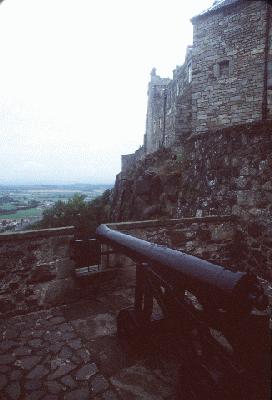
1. A replica heavy cannon stands silent vigil over the front of Stirling Castle. Not that any assault from this side had much chance of succeeding -- the cliff below the castle wall is several hundred feet high.
Inside, the castle seems even bigger -- one could easily get lost in there. For about a century it was used as home base for the Highland Regiments; I went through the regimental museum, and saw an amazing collection of artifacts from the Regiments' many deployments all over the world. There was an incredible table centerpiece that must have been three feet tall and I think was solid silver, with truly stunning workmanship. I wish I could have gotten a picture of it, but again they had a "no pictures" rule. No great matter; I could and did take lots of pictures of other things all round the castle.
Stirling City and Stirling Castle have a long, complex, and glorious history. Among many other noteworthy events, the valley below the castle was the site of William Wallace's incredible victory over the army of English king Edward I (Edward Longshanks) in September of 1297. Outnumbered by six to one, without heavy cavalry or longbowmen, the Scottish army still won the day thanks to English overconfidence and Wallace's brilliant strategy and leadership.
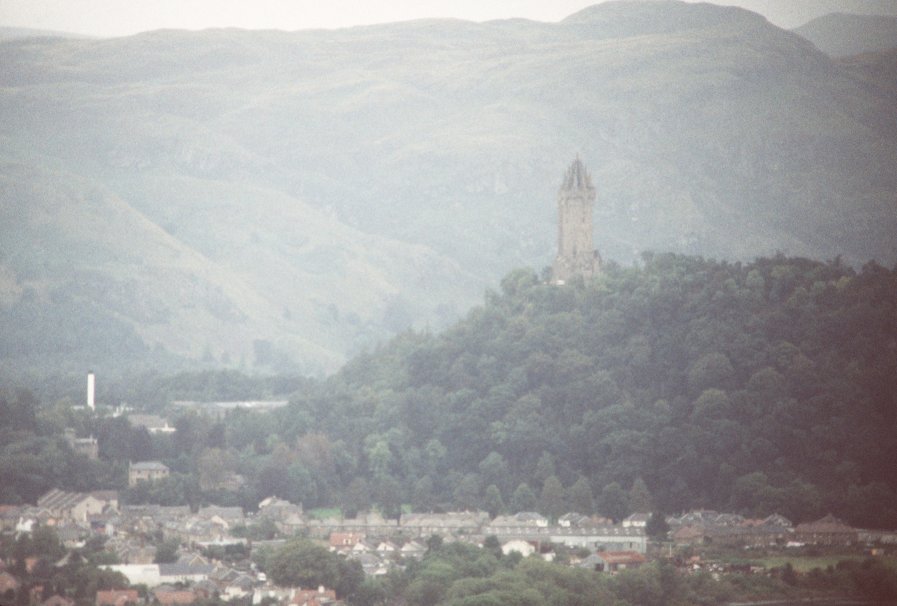
2. The Wallace Monument, raised to the memory of William Wallace, as seen from the ramparts of Stirling Castle.
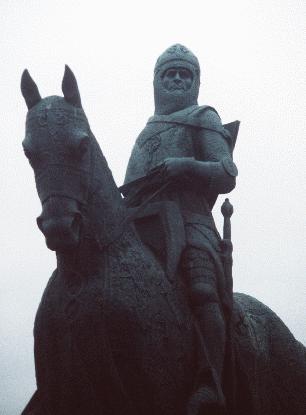
3. The statue of Robert the Bruce at Bannockburn battlefield.
From Stirling we went to Bannockburn battlefield, where Robert the Bruce finally gave Scotland effective independence in 1315 with a decisive military victory over another English army. There wasn't much to see at the battlefield. Just a statue of Robert the Bruce on horseback, a small monument with a plaque, and a series of displays describing the battle and showing what the land might have looked like when the battle was fought.
Then it was on to Edinburgh, where the official tour ended a bit after noon. In the afternoon, we got a private tour of the Royal Mile from members of Clanranald. The Royal Mile stretches from Edinburgh castle, atop a HUGE hill, down to Holyrood Palace. A bit more than halfway down is the place where the old Edinburgh city gates once were.
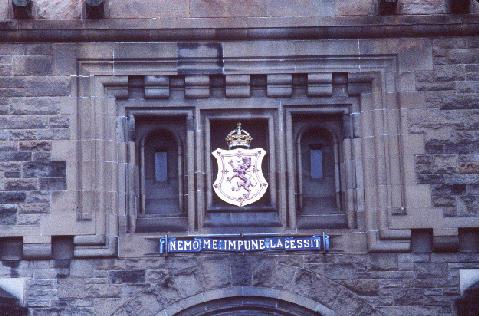
4. The Shield form of the Royal Coat of Arms of Scotland stands proudly above the entrance to Edinburgh Castle. The Latin motto below the crest is Nemo me impune lacessit, which translates roughly to English as "No one disturbs me with impunity."
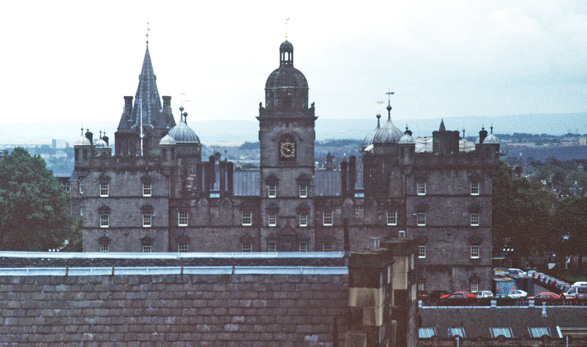
5. In Scotland, even the schools are pretty. This building near Edinburgh Castle is actually a school, and always has been.
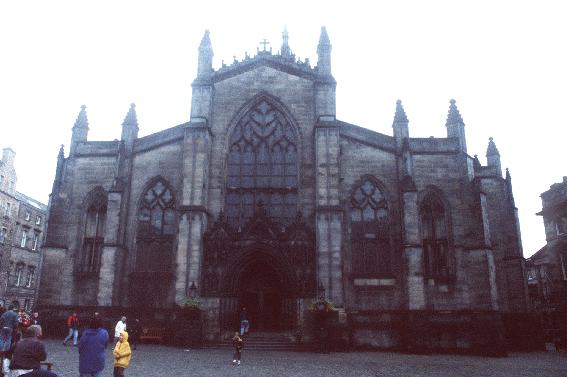
6. St. Giles Cathedral, about halfway down the Royal Mile.
After the tour, we scattered to separate hotels. Saturday was spent doing various touristy things like shopping, then we returned to the States on Sunday. Naturally, most of what I bought was books: a few books about Scottish history, and a new fantasy novel that wasn't available in the US yet. When I got back home and added these new books to several I'd already had, I found myself with about half a shelf's worth of books about Scotland.