The American Civil War
CannonFiring (46K)

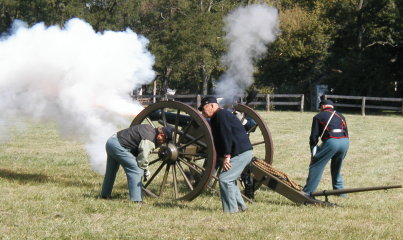
Re-enactors of Battery C, 1st Ohio Light Artillery, demonstrate the firing of a Civil War six-pounder light cannon. Battery C belongs to the Ohio Valley Civil War Association.

If you're interested in both military history and American history, it's hard to avoid being interested in the American Civil War, which grew directly from the country's history before 1860, and had repercussions which are still being felt today. I have a shelf-full of books about the Civil War, which can be roughly grouped into four categories:

General books about the war The Battle of Gettysburg Other battles and campaigns Books about weapons and tactics

General books about the entire Civil War

The centerpiece of my Civil War collection is four books by master historian Bruce Catton. In 1953, Catton wrote a single-volume history of the Civil War:

THIS HALLOWED GROUND
Catton, Bruce
c.1956, Washington Square Press
ISBN: 0-671-63884-X
There may be a better one-volume study of the Civil War, but if so, then I haven't seen it. Catton describes the entire war period, from the political crises of the late 1850s to the end of the war. Catton's research was exhaustive and his skill as a historian was beyond compare, and it shows on every page. He has a strong understanding of not only the military but also the social and political aspects of the war. He also has an impressive talent for descriptive writing, and for making the scenes come alive as few writers can.

Ten years later, Catton expanded This Hallowed Ground into his masterwork, The Centennial History of the Civil War:

  1. THE COMING FURY
    Catton, Bruce
    c.1961, Washington Square Press
    ISBN: 0-671-82445-7
    This first volume of the trilogy describes the twelve months leading up to the beginning of the war: the final breakdown of relationships between North and South, the growth of Southern secessionism, and the events that led to the attack on Fort Sumter.

  2. TERRIBLE SWIFT SWORD
    Catton, Bruce
    c.1963, Washington Square Press
    ISBN: 0-671-41131-4
    The second volume describes the first two years of the war, 1861 through early 1863.

  3. NEVER CALL RETREAT
    Catton, Bruce
    c.1965, Pocket
    ISBN: 0-671-80651-3
    The third and final volume covers the period from the Battle of Fredericksburg to the end of the war and Lincoln's assassination.

I have a few other general books about the war too:

AMERICAN HERITAGE PICTURE HISTORY OF THE CIVIL WAR
Catton, Bruce (text)
c.1960, American Heritage Press
ISBN: 0-517-38556-2
A giant coffee-table book that gives an overview of the Civil War using articles, essays, letters, battle diagrams, and some photographs.

BATTLE CRY OF FREEDOM
McPherson, James M.
c.1988, Ballantine
ISBN: 0-345-35942-9
Another single-volume history of the entire Civil War. Very good and very complete, much thicker than THIS HALLOWED GROUND. But I think McPherson isn't quite as good a writer as Catton was, so THIS HALLOWED GROUND is slightly the better of the two.

DECISIVE BATTLES OF THE CIVIL WAR
Mitchell, Joseph B., Lt. Col.
c.1955, Fawcett
ISBN: 0-449-30031-5

ECHOES OF GLORY: ILLUSTRATED ATLAS OF THE CIVIL WAR
c. 1998, Time-Life Books
ISBN 0-7370-3160-3
This is one of three books that make up the Time-Life Books boxed set Illustrated History of the Civil War. The other two are listed in the Weapons and Tactics section, below. This one gives descriptions and maps of the major battles of the war. The descriptions are rather sketchy and general, but the maps and other illustrations are extremely good.

Back to top

The Battle of Gettysburg

The Battle of Gettysburg is probably the single most written-about battle of the entire Civil War. It may even be the most written-about battle that ever took place on American soil. And for good reason: into its three days were packed everything that makes a battle worth studying. If you're interested at all in any aspect of warfare, you can find something to interest you in accounts of the Battle of Gettysburg.

GETTYSBURG: CULP'S HILL & CEMETERY HILL
Pfanz, Harry W.
c.1993, Univ. of N.C. Press
ISBN: 0-8078-2118-7
The second day of the Battle of Gettysburg included fighting all along the Union line, from Little Round Top at one end to Culp's Hill at the other. A lot has been written about the battles on the Union left, along the Emmitsburg Road and on the slopes of Little Round Top. This book describes and discusses the fighting on the other end of the line: the Union right, Cemetery Hill and Culp's Hill, which for some reason doesn't often get as much attention as it deserves. This book is part of a series of three that Pfanz wrote about Gettysburg, but I don't have the other two.

GETTYSBURG: STORIES OF MEN AND MONUMENTS
Hawthorne, Frederick
c.1988, ALBG
ISBN: 0-9657444-0-X
A guide to the many monuments and sculptures that decorate Gettysburg Battlefield National Park.

THE GETTYSBURG NOBODY KNOWS
An account of a side of the battle you don't often hear much about: the aftermath. The three days of fighting at Gettysburg produced an appalling list of casualties: more than five thousand dead and at least twice that many wounded and missing. Civil War combat medicine was extremely primitive by today's standards, and hundreds of men died of wounds or exposure in the days following the battle.

THE GREAT INVASION
Hoke, Jacob
c.1992, Stan Clark Military Books
ISBN: 1-879664-12-7
An account of Confederate General Robert E. Lee's decision to invade Pennsylvania in June 1863, and the campaign which followed.

HIGH TIDE AT GETTYSBURG
Tucker, Glenn
c.1958, Bobbs-Merrill
ISBN: 0-914427-82-2
A very detailed account of the entire Battle of Gettysburg, from the campaign that led to it through all three days of battle. Focuses on the leadership (or lack of it) shown by commanders on both sides.

STAND FIRM YE BOYS FROM MAINE
Desjardin, Thomas A.
c.1995, Oxford Univ. Press
ISBN: 0-19-514082-6
On July 2nd, 1863, the Twentieth Maine Regiment formed the anchor of the Union army's left flank, on the back slopes of Little Round Top. Its desperate stand against two Confederate regiments with more than twice as many soldiers was the stuff of legend, as well as being one of the most critical fights on a day filled with them. This book is a battle history of the Twentieth Maine, focusing on its battle at Little Round Top.

THEY MET AT GETTYSBURG
Stackpole, Gen. Edward A.
c.1956, Stackpole Books
ISBN: 0-8117-2089-6
The classic account of the Battle of Gettysburg. Other accounts have been written that cover one or another aspect of the battle in greater detail, but Stackpole's book seems to be generally accepted as the best over-all account of the battle from a military analyst's point of view.

Back to top

Other Civil War battles and campaigns

Gettysburg may be the most-written-about battle of the Civil War, but it's far from being the only major battle. It may not even be the most important single battle. The entire war is full of stories every bit as riveting as the Gettysburg campaign. These books discuss other significant battles of the war.

CHICKAMAUGA AND CHATTANOOGA: The Battles that Doomed the Confederacy
Bowers, John
c.1994, Avon Books
ISBN: 0-380-72509-6
This is a good look at the Chickamauga/Chattanooga campaign of fall 1863. In fall 1863, the Union Army of the Cumberland moved against a Confederate army in southern Tennessee. They met near the town of Chickamauga, and Confederate battle skill combined with Union mistakes let the Confederate army score a major victory. The Union army retreated into Chattanooga, where it was besieged and cut off from supplies. Union reinforcements under General Grant then broke the siege and drove off the Confederates in a series of fights that culminated in the storming of Missionary Ridge, one of only two occasions in the entire war where a frontal assault drove an opposing army out of an entrenched position on high ground.

HISTORY OF THE IRISH BRIGADE
Seagrave, Pia Seija (ed.)
c.1997, Sgt Kirkland's Museum
ISBN: 1-887901-03-5
The "Irish Brigade" was a set of regiments recruited mainly from first- and second-generation Irish immigrants living in New York State. The Brigade was part of the Army of the Potomac and fought in most of the major battles of the eastern campaign, including Antietam, Fredericksburg, Chancellorsville, and Gettysburg. The Irish Brigade regiments were viewed as elite troops and were frequently used to spearhead attacks. As a result, the brigade repeatedly took massive casualties and had to be completely rebuilt more than once. This is a collection of essays on the Irish Brigade and the battles it fought in.

THE MARCH TO THE SEA AND BEYOND
Glatthaar, Joseph T.
c.1985, Louisiana State Univ.
ISBN: 0-8071-2028-6
In fall 1864, a huge Union army under the command of General William Sherman left the conquered city of Atlanta and marched from there to the coastal city of Savannah. The "March to the Sea" was like no other campaign of the Civil War. The army lived off the land and methodically destroyed everything of military value in its line of advance.

SHERMAN'S MARCH
Davis, Burke
c.1980, Vintage Books
ISBN: 0-394-75763-7
Another look at the March to the Sea, based on firsthand accounts from the soldiers who made up Sherman's great army.

THUNDER ALONG THE MISSISSIPPI
Coombe, Jack D.
c.1996, Bantam Books
ISBN: 0-553-37967-4
From 1861 to 1863, the Union army fought a unique campaign along the length of the Mississippi River. Its ultimate goal was to cut the western Confederate states from the eastern ones. Using the new technology of powered riverboats as an "inland navy", the Union forces methodically moved south from Cairo, Illinois, taking control of the river as they went. In late 1862 a Union force attacked New Orleans at the southern end of the river, and began a second assault from the south. This book describes and discusses the series of campaigns that conquered the Mississippi and split the Confederacy in two, culminating in the conquest of Vicksburg in summer 1863.

Back to top

Weapons and Tactics of the Civil War

These books discuss general weapons and tactics of the Civil War, and some of its implications for military history. In many ways the Civil War marked a fundamental shift in the nature of warfare, from the old Napoleonic style in which the manpower of massed infantry mattered most to a newer style in which firepower was most important. Many new weapons made their first appearance in the Civil War, including the long-range rifle, explosive artillery rounds, and rapid-firing repeater firearms.

THE AMERICAN CIVIL WAR AND THE ORIGINS OF MODERN WARFARE
Hagerman, Edward
c.1988, Indiana Univ. Press
ISBN: 0-253-20715-0
In many ways the American Civil War marked a fundamental shift in the way that land wars were fought. Massed infantry charges and organized lines of musket-men gave way to long-range heavy artillery, defensive works, and rapid-fire repeating rifles. This book looks at the ways in which Civil War weapons, tactics, and strategy changed warfare forever, and foreshadowed the awful slaughter and slogging trench warfare of World War I.

ECHOES OF GLORY: ARMS AND EQUIPMENT OF THE CONFEDERACY
Various
c.1998, Time-Life Books
ISBN: 0-7370-3159-X
One of a set of three books from Time-Life Books which are collected in the boxed set Illustrated History of the Civil War. This one is a detailed examination of the weapons and equipment used by Confederate soldiers and sailors during the Civil War. It includes small arms, cannons, personal equipment kit, and uniforms.

ECHOES OF GLORY: ARMS AND EQUIPMENT OF THE UNION
Various
c.1998, Time-Life Books
ISBN: 0-7370-3158-1
One of a set of three books from Time-Life Books which are collected in the boxed set Illustrated History of the Civil War. This one is a detailed examination of the weapons and equipment used by Union soldiers and sailors during the Civil War. Like the volume about Confederate arms and equipment, it includes small arms, cannons, personal equipment kit, and uniforms.

Back to top